Thursday, December 25, 2025
Home Blog Page 235

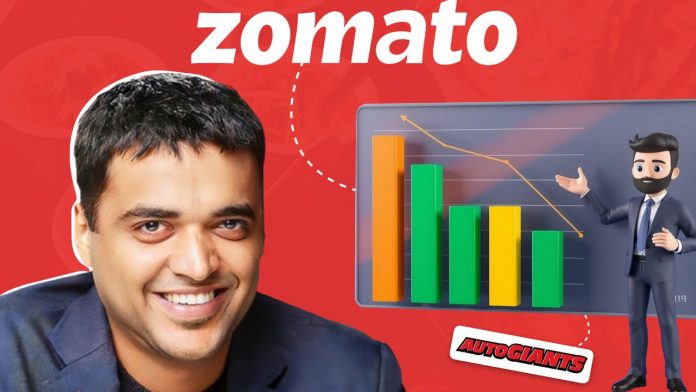
Zomato stock gains 4.6%, ends day 2.9% higher on Q2 results

0

Zomato stock gains 4.6%, ends day 2.9% higher on Q2 results

Zomato shares jumped 4.6% to INR 268 on the BSE on Wednesday, October 23, following the company’s quarterly financial report.

However, the stock gave up some gains to close 2.9% higher at INR 263.85 on the BSE. A total of 16.16 crore Zomato shares were traded today. The company’s market value stood at INR 2.3 lakh crore (about $27.7 billion) by the end of the day.

Continue Exploring: Zomato’s net profit drops 30% to INR 176 Cr in Q2 FY25 

Zomato’s shares performance returns 111.93%

In the bigger market, the Sensex dropped 138.7 points (0.17%) to 80,081.98, and Nifty50 fell 36.60 points (0.15%) to 24,435.50. Zomato’s shares have been rising for the past year due to better financial performance, giving a 111.93% return so far this year.

Meanwhile, in Q2 FY25, Zomato’s net profit increased by 389% year-on-year to INR 176 Cr. However, net profit fell by 30% from INR 253 Cr in Q1 FY25 due to Blinkit’s expansion costs. Despite this, brokerages are still positive about the stock. Axis Securities kept its buy rating on Zomato with a target price of INR 350.

Blinkit to achieve 20%+ growth in 5 years

According to INC42, the brokerage said, “Strong demand from the top 10 cities for food order delivery is expected to continue. Blinkit is anticipated to achieve 20%+ growth over the next 5 years, supported by growing demand, a better brand, and superior execution.” Nuvama kept its buy rating with a price target of INR 325 for the stock.

Continue Exploring: Varun Beverages achieves 24% revenue growth, 22% PAT surge in Q3CY24

“Zomato continues to push the paddle of growth across its business.We expect Blinkit dark store addition to be faster than initially expected—hence growth shall be even faster while profitability would be delayed due to higher upfront cost thereof, which, in our view, is the right strategy in a cut-throat QC market,” Nuvama further added.

Amid the festive season, Zomato raised its platform fee to INR 10. The company earned INR 75 Cr from the platform fee in the quarter ending September 2024.Zomato shares jumped 4.6% to INR 268 on the BSE on Wednesday, October 23, following the company’s quarterly financial report.

However, the stock gave up some gains to close 2.9% higher at INR 263.85 on the BSE. A total of 16.16 crore Zomato shares were traded today. The company’s market value stood at INR 2.3 lakh crore (about $27.7 billion) by the end of the day.

Continue Exploring: Zomato’s net profit drops 30% to INR 176 Cr in Q2 FY25 

Zomato’s shares performance returns 111.93%

In the bigger market, the Sensex dropped 138.7 points (0.17%) to 80,081.98, and Nifty50 fell 36.60 points (0.15%) to 24,435.50. Zomato’s shares have been rising for the past year due to better financial performance, giving a 111.93% return so far this year.

Meanwhile, in Q2 FY25, Zomato’s net profit increased by 389% year-on-year to INR 176 Cr. However, net profit fell by 30% from INR 253 Cr in Q1 FY25 due to Blinkit’s expansion costs. Despite this, brokerages are still positive about the stock. Axis Securities kept its buy rating on Zomato with a target price of INR 350.

Blinkit to achieve 20%+ growth in 5 years

According to INC42, the brokerage said, “Strong demand from the top 10 cities for food order delivery is expected to continue. Blinkit is anticipated to achieve 20%+ growth over the next 5 years, supported by growing demand, a better brand, and superior execution.” Nuvama kept its buy rating with a price target of INR 325 for the stock.

Continue Exploring: Varun Beverages achieves 24% revenue growth, 22% PAT surge in Q3CY24

“Zomato continues to push the paddle of growth across its business.We expect Blinkit dark store addition to be faster than initially expected—hence growth shall be even faster while profitability would be delayed due to higher upfront cost thereof, which, in our view, is the right strategy in a cut-throat QC market,” Nuvama further added.

Amid the festive season, Zomato raised its platform fee to INR 10. The company earned INR 75 Cr from the platform fee in the quarter ending September 2024.

Advertisement

Bikaji to acquire 53% stake in Lucknow’s Hazelnut Factory, enters QSR segment

0
Food & Beverages, Cloud Kitchen, QSR Segment, FMCG
Bikaji to acquire 53% stake in Lucknow’s Hazelnut Factory, enters QSR segment

Bikaji Foods International Limited, a major Indian ethnic snack brand, is entering the Quick Service Restaurant (QSR) sector. Its subsidiary, Bikaji Foods Retail Limited (BFRL), will invest Rs 131.01 crore to buy a 53.02% stake in Lucknow-based café and sweets brand, Hazelnut Factory Food Products Private Limited (The Hazelnut Factory).

Bikaji aims to diversify into artisan bakery and café-style items

The investment will happen in stages over the next two years, marking Bikaji’s move into premium bakery and café products to meet changing consumer tastes in India’s retail market. This acquisition would help Bikaji diversify its products into artisan bakery products and café-style food items. The Hazelnut Factory has six stores in Lucknow, one store in Kanpur, and one in Delhi, providing specialty coffee, artisanal sweets, as well as several bakery and café products.

Continue Exploring: Tata Starbucks opens second experiential coffee store in Colaba, Mumbai

According to Indian Retailer.com, Deepak Agarwal, MD of Bikaji Foods International mentioned in a media release, “This acquisition marks a significant step in Bikaji’s journey to expand beyond traditional ethnic snacks and enter into retail QSR, premium artisanal sweets, and the bakery segment. By integrating The Hazelnut Factory’s premium offerings with Bikaji’s manufacturing capabilities, we aim to cater to unique customer tastes and preferences, establishing Bikaji as a key player in the QSR space.”

The Hazelnut Factory eyes growth through Bikaji networks

This acquisition helps Bikaji build a “House of Brands,” offering cross-selling opportunities, a wider customer base, and a bigger market presence. Ankit Sahni, Founder of The Hazelnut Factory, said, “With our innovative culinary offerings and Bikaji’s strong distribution network and operational excellence, we are well-positioned to accelerate our growth.”

Continue Exploring: Licious covers losses by 44% YoY to INR 293.77 cr 

This move comes as India’s QSR segment grows quickly. Urbanisation, a young population, and food aggregators are driving this growth in tier-2 and tier-3 cities. With the Hazelnut Factory acquisition, Bikaji aims to tap into this fast-growing market.

Advertisement

Licious covers losses by 44% YoY to INR 293.77 cr 

0
Food & Beverages, Retail, E-commerce, Quick Commerce, Licious
Licious covers losses by 44% YoY to INR 293.77 cr 

Licious, a Bengaluru-based meat delivery startup, revealed that its losses decreased by 44% to INR 293.77 crore in FY24 from INR 528.5 crore the previous year. In addition, its revenue fell by 8.4% to INR 685.05 crore from INR 748 crore in FY23.

Decline in sales on Dunzo and Swiggy Meatstore contributes to Loss

According to INC42, the startup said its revenue drop is due to stopping sales on Dunzo and Swiggy Meatstore, and reducing its presence in modern trade and local stores. The D2C brand makes money by selling meat, seafood, cold-cuts, and ready-to-eat meat items online.

Continue Exploring: Tata Starbucks opens second experiential coffee store in Colaba, Mumbai

However, Licious said the revenue drop was balanced by a 35% year-on-year growth in quick commerce deliveries. Due to high demand for fast deliveries, the startup is testing 30-minute meat deliveries in Gurugram and moving to a full-stack D2C model. They also mentioned that 85% of their revenue came from their own app and they deliver meat to 1.2 million consumers monthly through it.

Licious acquires My Chicken to expand offline presence

Additionally, Licious plans to expand its offline store network aggressively. They recently acquired Bengaluru-based retailer My Chicken and More, increasing their offline retail points to 26. Although the financial details were not disclosed, Licious said the acquisition will add 23 more stores to its network, expanding its offline presence.

Continue Exploring: Amazon India launches campaign to protect customers from cyber fraud

With its offline expansion, the startup expects to break even or become profitable this financial year. In FY23, the D2C startup’s EBITDA margin was -58.9%.

Meanwhile, Licious co-founders Ajay Hanjura and Vivek Gupta released a statement saying, “We are now focused on building a full-stack distribution operation through an omnichannel strategy. Last year has been a transition, with short-term impacts from strategic adjustments. However, we expect to see the positive results of these choices by the end of FY25.”

Notably, Licious let go of about 80 employees in FY24 as part of a restructuring exercise.

Advertisement

Tata Starbucks opens second experiential coffee store in Colaba, Mumbai

0
Starbucks, coffee brand, food & beverages, retail, retail sector
Tata Starbucks opens second experiential coffee store in Colaba, Mumbai

TATA Starbucks has inaugurated its second experiential coffee store in India at Dhanraj Mahal in Colaba, Mumbai. This store honours Mumbai’s architectural heritage and offers a unique coffee experience.

Starbucks first experiential coffee store in New Delhi

After the success of its first store in New Delhi, TATA Starbucks continues to mix India’s rich flavours and culture with its global coffee expertise, expanding its presence in India. The store’s menu features local ingredients like jaggery, chili, shikanji, guava, and tamarind, showcasing India’s culinary traditions. Signature drinks include Malabar Coconut Cream Latte, Cinnamon Jaggery Latte, Cocoa Birds Eye Chilli Latte, and Tamarind Shikanji. They also offer freshly baked croissants, sandwiches, and scrambled eggs made in-house for a unique coffee and dining experience.

Continue Exploring: Amul to expand in US mainstream retail market via Costco

According to India Retailer.com, Sushant Dash, CEO of TATA Starbucks mentioned, “The launch of our second coffee experiential store reflects our commitment to celebrating coffee heritage through variety, artistry, and food theatre, complemented by a host of international coffee experiences.”

Starbucks to honours Mumbai’s culture with experiential store

Furthermore, He stated, “A decade ago, our journey began in Mumbai, and this store honours the city’s rich cultural tapestry and vibrant community. It’s not just a tribute to the heritage of Starbucks; it’s a celebration of the community and Third Place experience. As we continue to elevate our legacy in Mumbai, we’re dedicated to offering our customers unique coffee experiences and memorable connections.”

Continue Exploring: Mamaearth Chief Product and Technology Officer Jayant chauhan resigns due to personal reasons

Meanwhile, the store offers a wide coffee selection, with five exclusive espresso bean options and thirteen whole bean choices from top coffee-growing regions like India, Kenya, Sumatra, and Latin America. Coffee lovers can enjoy a globally curated range, including Starbucks Willow Blend, Single-Origin Zambia, Single-Origin Colombia, Pike Place Roast, and House Blend.

Notably, the new store combines traditional and modern design in Dhanraj Mahal, an Art Deco building. It honours Mumbai’s cultural history while providing a welcoming space that mixes Indian and world-class design.

Advertisement

Amazon India launches campaign to protect customers from cyber fraud

0
Amazon, E-commerce, Retail , Retail news
Amazon India launches campaign to protect customers from cyber fraud

Amazon India has started a digital campaign to help customers stay aware of cyber frauds and scams amid the busy Great Indian Festival.

Amazon #AapkeHittMeJaari campaign

To educate users on safe online transactions, e-commerce giant has launched the #AapkeHittMeJaari campaign on YouTube Shorts. The campaign raises awareness about phishing scams, OTP frauds, lottery cons, and hiring scams, the company said.

Continue Exploring: Swiggy Instamart faces criticism for adding free Tomatoes to cart, netizens slam

As per INC42, Amazon mentioned, “The videos shed light on phishing and hiring scams, using the backdrops of modern dating woes, office meetings and festive shopping excitement.” Besides entertaining, it educates users on not sharing CVV/OTP numbers, checking URLs and email headers, and spotting people pretending to be associated with Amazon.

Amazon introduces ‘Rufus’ AI and fulfilment centres for customers

Interestingly, the online marketplace is engaging shoppers with various initiatives during its festive sale. Last month, Amazon India introduced Rufus, a generative AI-powered shopping chatbot, before the Great Indian Festival sale. The chatbot aims to improve customer experience and simplify shopping using AI.

Continue Exploring: Temasek to acquire 25% stake in IPO-bound Rebel Foods

In the previous month, Amazon opened three new fulfilment centres in Delhi NCR, Guwahati, and Patna to help over 2.5 lakh sellers in the region. These centres have a combined storage space of 1.2 million cubic feet, allowing sellers to better serve customers and create job opportunities.

To encourage more sellers to join the platform, Amazon India announced it would reduce selling fees by up to 12% across various product categories In August.

Advertisement

Amul to expand in US mainstream retail market via Costco

0
Amul ,amul brand, FMCG, Retail
Amul to expand in US mainstream retail market via Costco

Six months after stepping out of India, Amul‘s ‘Taste of India’ is coming to the US. Gujarat Cooperative Milk Marketing Federation (GCMMF), which sells products under the Amul brand, has teamed up with US retailer Costco to provide Amul fresh milk to the Indian community and American consumers.

Amul gallon packs are now available at Costco Wholesale

On Tuesday, Amul Gold entered the US mainstream retail market with gallon packs (3.78 litres) now available at Costco Wholesale, ET reported. Jayen Mehta, managing director of GCMMF, said, “It is a proud moment for us as we have entered mainstream retail in the US.” 

Continue Exploring: Temasek to acquire 25% stake in IPO-bound Rebel Foods

Notably, Costco also sells its own Kirkland Signature milk. Mehta added, “Our unique 6% fat formulation of Amul Gold has attracted not just the Indian diaspora but also American consumers. After we launched Amul fresh milk in May, it was widely accepted. It was so far available at all prominent supermarket chains and grocery stores that serve the Indian diaspora. With Costco being one of the largest retail chains, we have strategically launched Amul products to make them widely available across the US market.”

Meanwhile, Amul began supplying Amul Gold packs to Costco stores on the east coast. Soon, it will be available in all 750 Costco stores. India’s largest milk cooperative will also launch other dairy products like curd, buttermilk, and fresh cream in the US to meet the growing demand from the Indian community.

Amul first ventures into US via MMPA in 2023

In the previous year, Amul entered the US market by collaborating with Michigan Milk Producers Association (MMPA), America’s tenth-largest dairy cooperative. This marked Amul’s first venture outside India. The partnership between Amul and the 108-year-old MMPA continues the brand’s bonds with Michigan.

Continue Exploring: Evenflow secures unspecified bridge round, eyes IPO in 2027

Interestingly, Dr. Verghese Kurien, known as India’s Milkman and founder chairman of GCMMF, was an alumnus of Michigan State University. He led the country’s White Revolution. Through its partnership with MMPA, Amul launched its popular fresh milk in the US with the same brand and composition as in India.

Founded in 1916, MMPA is a dairy farmer-owned cooperative serving Michigan, Ohio, Indiana, and Wisconsin. Amul uses MMPA’s advanced technology for fresh milk products in the US. It has four processing facilities: a cheese plant in Indiana, a dairy products plant in Ohio, and two dairy ingredient setups in Michigan.

Advertisement

Temasek to acquire 25% stake in IPO-bound Rebel Foods

0
rebel foods, food brand retail FMCG E-commerce
Temasek to acquire 25% stake in IPO-bound Rebel Foods

Temasek Holdings, a Singapore state investor, plans to buy a major stake in Rebel Foods through a mix of new equity and buying existing shares as the cloud kitchen unicorn, is preparing to announce its Initial Public Offering (IPO).

Temasek to invest $200 million, becomes largest investor

According to Mint, some of the early funding partners are Coatue Management, Lightbox, and Peak XV. Additionally, these companies are selling some shares and reducing their stakes before the startup’s IPO in the next 12-18 months.

Continue Exploring: Evenflow secures unspecified bridge round, eyes IPO in 2027

Meanwhile, Temasek’s subsidiary, Jongsong Investments, will buy these shares, representing a 20-25% stake in Rebel Foods, for about $180-200 million (approx. INR 1500-1680 crore), according to the report. If the deal goes through, Temasek will be the largest shareholder in Rebel Foods. The founders own 12% and Qatar Investment Authority owns about 10%. Furthermore, Rebel Foods plans to use the new funds to grow its food court business, EatSure.

Rebel Food revenue surges to INR 1,420.2 cr in FY24

Established in 2011 by Kallol Banerjee and Jaydeep Barman, Rebel Foods runs several quick service restaurant (QSR) brands like Behrouz Biryani, Ovenstory Pizza, The Good Bowl, SLAY Coffee, and Wendy’s. The startup makes money by selling food from its own cloud kitchens and third-party kitchens. It also earns from delivery charges and royalties through collaboration with other companies.

Continue Exploring: Mamaearth Chief Product and Technology Officer Jayant chauhan resigns due to personal reasons

Notably, Rebel Foods cut its net loss by 42% to INR 378.2 crore in FY24 from INR 656.5 crore the previous year through higher revenue and controlled costs. Its operating revenue rose 19% to INR 1,420.2 crore in FY24 from INR 1,195.2 crore in FY23. This second stake purchase comes as many late-stage Indian startups are seeing early investors sell shares before their IPOs to make profits.

Moving forward, Startups like Urban Company, Swiggy, and Lenskart have had secondary transactions before their IPOs, giving early investors partial exits and high returns.

Advertisement

Evenflow secures unspecified bridge round, eyes IPO in 2027

0
D2C, Quick Commerce, Supply Chain,
Evenflow strengthens Quick Commerce, D2C and supply chain verticals with new heads

House of Brands Evenflow has secured an unspecified amount from serial entrepreneur Shail Patel and existing investors in a bridge round. This is part of its ongoing $5 million Series A round, the company announced on Tuesday, October 15.

Evenflow set to expand 7 acquired brands globally

This new investment will help expand operations and grow all seven acquired brands — Xtrim, Yogarise, Rusabl, BabyPro, Trendy Homes, Cinagro, and Frenchware. Evenflow aims to take these brands global by entering more countries. In addition, a bridge round is temporary funding to support a company until the next big round.

Continue Exploring: Jewellery startup Bluestone targets INR 2100 cr through IPO by FY25

According to Economic Times, Utsav Agarwal, chief executive officer (CEO), of Evenflow, mentioned, “Currently, we view ourselves more as a mutual fund than a high-growth stock. Our focus is on low risk and stable returns, rather than high risk and volatile returns. This approach is in line with the preferences of our current investors and Shail Patel, which is why they have shown confidence through their investment. We are excited to utilize this capital for our people and for growth, and ultimately prepare for an IPO by the end of 2027.”

Evenflow sees 350% growth on e-commerce platforms

For now, the brands maintained their presence in India and the US, and they’ve seen a strong 350% growth by selling on e-commerce platforms. Evenflow brands are available on platforms like Amazon, Flipkart, CRED, Zepto, Instamart, and more.

Continue Exploring: D2C footwear brand Yoho secures INR 27 Cr in Pre-Series B funding for expansion

Furthermore, Shail Patel, Director at Adjavis Venture Limited, released a statement regarding the funding, saying, “India is going through a massive shift in the adoption of challenger brands across categories. It presents a unique opportunity over the next decade to build everyday brands that turn into household names. Evenflow is capitalising on this very opportunity with positive unit economics, and hence I am excited to back them.”

Established in 2021, Evenflow has granted investments from 100unicorns, Village Global, Equanimity, Kunal Shah, Vijay Shekhar Sharma, Emil Michael, Sandeep Varaganti, Srinath Rajam, and more across several rounds. They aim to grow revenue by 10x and profits by six times by 2027 through building a strong team, scaling the business, and keeping a healthy profit margin.

Advertisement

Mamaearth Chief Product and Technology Officer Jayant chauhan resigns due to personal reasons

0
D2C, Retail , Mamaearth , Jayantchauhan

Jayant Chauhan, the Chief Product and Technology Officer of Mamaearth‘s parent company, Honasa Consumer, has stepped down from his role, according to a stock exchange filing by the company.

Jayant mentioned in his resignation letter to Honasa Consumer’s founder and CEO, Varun Alagh, “Due to personal reasons, I would like to tender my resignation from the post of chief product and technology officer of the company. My last working day with the organisation would be 30th November 2024.”

Continue Exploring: D2C Brands outpace marketplaces with 64% increase in festive Sales

Jayant Joined Mamaearth in 2020, Previously Part of Policybazaar

At Mamaearth, Jayant, who graduated from IIT Delhi, was in charge of product strategy and engineering. He headed the product development and infrastructure teams at the company’s Gurugram office. He joined the beauty and personal care company in November 2020. Before that, he was the chief product officer at Policybazaar and also worked at Paytm, Airtel, and Zomato.

Meanwhile, shares of Honasa Consumer rose 0.9% to Rs 428.90 on Tuesday at the BSE. Chauhan’s resignation was announced after market hours. He was classified as a “senior management personnel” by the company.

Continue Exploring: Swiggy Instamart faces criticism for adding free Tomatoes to cart, netizens slam

Mamaearth’s Honasa Consumer sees growth of 19% YoY

In addition to Chauhan and co-founders Varun and Ghazal Alagh, Honasa Consumer’s senior management includes CFO Raman Preet Sohi, chief business officer Zairus Master, CMO Anuja Mishra, and company secretary Dhanraj Dagar. In August, senior vice president of commercial, Abhishekk Raj Pandey, who led sourcing, procurement, and manufacturing, left to co-found salon management software firm Zalon.

Moving further, Honasa Consumer’s operating revenue increased by 19% YoY to INR 554 crore for the April-June quarter. Their net profit went up by 62% YoY to INR 40 crore.

Advertisement

D2C Brands outpace marketplaces with 64% increase in festive Sales

0
D2C, E-Commerce, Quick Commerce
D2C Brands outpace marketplaces with 64% increase in festive Sales

Direct-to-consumer (D2C) brands saw a 64% increase in orders during the recent sale, outpacing marketplaces, which had a 26% growth from last year, Gokwik reported.

E-commerce Sales Surge During Dussehra Festive Week

According to Economic Times, this change shows that shoppers now trust D2C brands more, making them less dependent on marketplace sales. Major Indian eCommerce platforms had their biggest festive sales from September 25 till Dussehra. Before, D2C brands saw fewer orders during this time, but that has changed since last year.

Continue Exploring: Swiggy Instamart faces criticism for adding free Tomatoes to cart, netizens slam

Now, D2C brands are running strong sales alongside marketplaces and seeing more orders. GoKwik’s Co-Founder and CEO, Chirag Taneja shared, “D2C is here and thriving, the ecosystem is expanding and the market is deepening.” He further said, “Shoppers are more confident about placing their bets on D2C now more than ever. The personalisation, niche products, and seamless shopping experience brands have been providing to these shoppers is reaping results.”

Footwear and Jewellery surge, electronics lag due to market competition

Meanwhile, footwear, usually bought in stores, led growth with a 273% increase in orders. Fashion & beauty followed with 84% and 73% growth, respectively. Jewellery, typically bought online, saw a 38% increase in orders. This shows growing trust in D2C brands, even for items usually bought offline.

However, electronics saw a 3% decrease in orders, likely due to the growth of Quick Commerce, big discounts on marketplaces for items like phones and TVs, and more people shopping in stores where deals match online offers.

Continue Exploring: Blinkit rolls out 10-minute return option for clothing and footwear

Notably, the Average Order Value (AOV) for D2C brands increased by 11% year-on-year, rising from INR 1,368 to INR 1,869. Jewellery, once viewed sceptical in early eCommerce days, saw the biggest jump, with AOV growing from INR 1207 in 2023 to INR 1809 this year.

E-commerce Sees 5% Increase in Prepaid Orders

Payment behaviours have changed too. GoKwik’s data shows a 5% rise in prepaid orders, especially in fashion, where more shoppers are paying upfront. Chirag explained, “While UPI continues to be shoppers’ favourite prepaid mode of payment, EMI also seems to be the flavour of the season. With GenZ shopping more and more, brands are bridging the gap between aspiration and affordability by providing easy and flexible EMI options.”

With a 96% spike, tier 1 cities saw the biggest increase in orders, which is unusual for the festive season. Normally, Tier 3 cities lead in order surges during this time. Tier 1 cities also had the highest rise in Average Order Value (AOV). States like Maharashtra, Karnataka, Uttar Pradesh, Delhi, and Tamil Nadu had the highest order volumes.

Looking further, GoKwik backs over 10,000 brands like Lenskart, Neemans, Man Matters, and Shoppers Stop. These brands cover fashion, beauty, health, electronics, and other key online shopping areas.

Advertisement