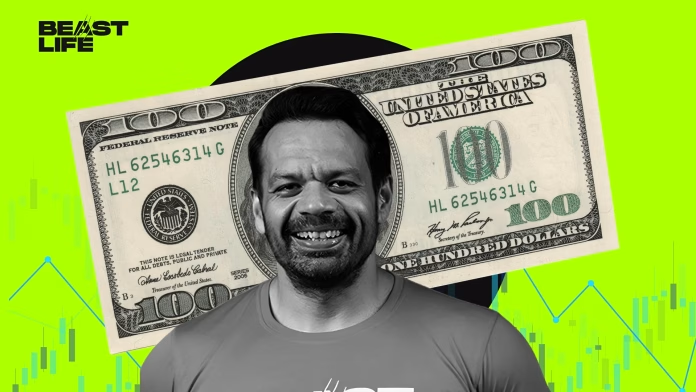
Gurugram-based BeastLife has emerged as one of the fastest-scaling brands in India’s sports nutrition segment, transitioning from a niche D2C startup in 2024 to a ₹320 crore valuation within two years. Founded by Gaurav Taneja and Raj Vikram Gupta, the company has combined creator-led trust with operational execution to build a high-growth, performance-focused brand in a category traditionally dominated by legacy supplement players.
The company’s financial trajectory reflects accelerated scale. Revenue grew from ₹36 crore in FY25 to approximately ₹100 crore in FY26, with an annualized run rate of ₹150 crore. This growth has been supported by strong digital demand and increasing brand recall within the fitness community. Over the medium term, BeastLife is targeting ₹500 crore in revenue, indicating an aggressive expansion roadmap anchored in both product innovation and distribution scale.
Capital infusion has played a critical role in enabling this growth. In April 2025, the company raised ₹1.9 crore with participation from Rinku Singh, which helped establish early visibility and brand credibility. This was followed by a ₹20 crore Pre-Series A round in April 2026 led by GVFL and Equentis, providing the resources required to invest in research and development, strengthen the leadership team, and expand distribution channels. The funding trajectory also underpins the sharp valuation increase from ₹120 crore to ₹320 crore within a year.
A key differentiator for BeastLife lies in its focus on proprietary product development. The launch of Creatine Nano 400 marks a strategic shift toward science-led innovation, positioning the brand beyond commodity protein supplements. By leveraging nano-engineering and advanced delivery mechanisms, the company aims to address absorption efficiency and performance outcomes—areas that remain underdeveloped in much of the domestic supplement market. This approach signals an intent to build defensible intellectual property rather than relying on standard formulations.
On the distribution front, BeastLife is evolving into an omnichannel brand. While digital channels remain the primary growth engine—spanning its own platform, marketplaces, and quick commerce—the company is selectively entering offline retail. The focus is on high-throughput environments such as gyms and specialty nutrition stores, where product education and trial can drive higher conversion. This calibrated expansion allows the brand to maintain capital efficiency while increasing physical visibility.
Looking ahead, BeastLife is also evaluating international opportunities, particularly in markets receptive to performance nutrition and clean-label formulations. The combination of domestic scale and differentiated product innovation provides a foundation for global expansion, although execution will depend on regulatory alignment and localized market strategies.
BeastLife’s evolution highlights a broader shift within India’s fitness ecosystem. The category is moving from influencer-led marketing toward performance-driven, research-backed products supported by disciplined distribution. By aligning community reach with product differentiation and capital efficiency, the brand is positioning itself as a long-term contender rather than a short-cycle D2C phenomenon.