Monday, February 16, 2026
Home Blog Page 2

Jaipur McDonald’s Outlet Pulled Up Over Rotten Tomatoes, Reused Oil

0
Jaipur McDonald’s Outlet Pulled Up Over Rotten Tomatoes, Reused Oil

Food safety authorities in Jaipur have issued a formal warning to a local outlet of McDonald’s after an inspection revealed the use of cooking oil deemed unfit for consumption and the presence of rotten tomatoes in storage.

The inspection was carried out earlier this week in Jaipur, Rajasthan. According to government food safety officer Sushil Chotwani, officials found approximately 40 litres of cooking oil that had been repeatedly used and classified as unsuitable for consumption under food safety norms. Samples of the oil were collected and sent for further testing.

Inspectors also found spoiled tomatoes stored at the outlet, raising additional compliance concerns. The violations prompted authorities to issue a warning notice to the restaurant.

The outlet has been given 14 days to rectify its practices, failing which stricter regulatory action may follow. Officials have also indicated that additional inspections of other McDonald’s outlets in Jaipur will be conducted as part of a broader review.

In response, Connaught Plaza Restaurants, the franchisee operating McDonald’s outlets in North and East India, said it is cooperating with authorities and adheres to the brand’s global quality and food safety standards. The parent company did not immediately respond to queries.

While food adulteration and safety violations are periodically reported across India, lapses involving large multinational restaurant chains remain relatively uncommon. The development has once again brought food safety standards at high-profile outlets into focus.

McDonald’s operates hundreds of outlets across India and remains one of the country’s most recognised quick-service restaurant brands.

Advertisement

From Cola to Coffee, India Goes Low-Sugar as Health Trends Go Mainstream

0

India’s love affair with sugary drinks is cooling — and zero-sugar beverages are stepping into the spotlight.

Sales of zero- and low-sugar drinks climbed to a five-year high in 2025, marking a clear shift from what was once dismissed as an urban health fad to a full-blown mainstream trend. Industry data shows the segment’s share has surged to an average 30% of total beverage sales in 2025, up sharply from just about 5% in 2020.

Leading the charge is Coca-Cola, where zero-sugar variants now account for 30% of total volumes. This includes Diet Coke, Coke Zero, Thums Up X Force (no-sugar), Sprite Zero, Kinley water, and select juice and energy drink options. Diet Coke alone saw its sales double year-on-year. Coca-Cola currently leads India’s ₹60,000 crore-plus soft drinks market.

Rival PepsiCo is witnessing a similar shift. Its no-sugar and mid-sugar portfolio contributed 59% of total volumes in the October–December 2025 quarter, up from 53% a year earlier, according to bottling partner Varun Beverages. The portfolio includes Pepsi Black, 7 Up Zero Sugar, Sting energy drink, Tropicana no-sugar variants, Evervess Soda, and Aquafina water — marking the company’s strongest year-on-year jump in this category.

Executives attribute the surge to rising health awareness, changing consumer behaviour, and stronger participation from Gen Z. Industry insiders say Indian consumers are now paying closer attention to calorie intake and ingredient labels — without giving up flavour or indulgence.

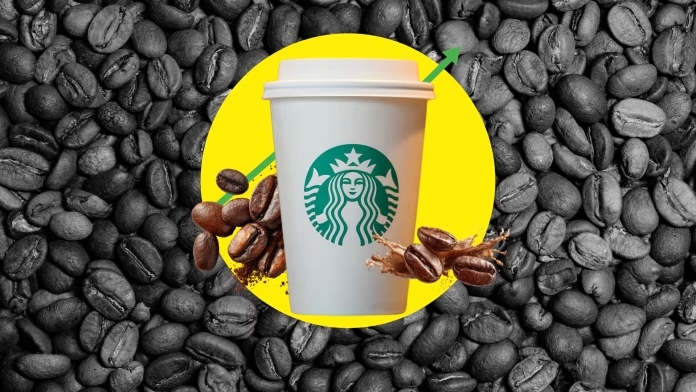
The trend is no longer limited to fizzy drinks. Coffee chains are also responding to evolving preferences. Tata Starbucks introduced sugar-free flavour options across more than 500 stores in January, citing increased demand for customisable sweetness levels. According to company executives, the start of the year — driven by New Year resolutions and lifestyle resets — typically sees heightened interest in lower-calorie choices.

Coca-Cola is pushing affordability as well, expanding sugar-free offerings at accessible price points starting from ₹10. The company is also introducing no-sugar variants under Schweppes and leveraging digital campaigns to promote newer consumption trends, such as blending Diet Coke with espresso.

Industry observers say India’s urban consumers have reached a generational inflection point in wellness trends, with both health consciousness and aesthetic motivations playing a role. The increasing adoption of diabetes and weight-management drugs such as semaglutide and tirzepatide is also reinforcing dietary shifts.

Investor interest is following consumer behaviour. Direct-to-consumer brands focused on low- or no-sugar positioning — such as Go Zero, Yummy Bee, and Chini Kum — have attracted fresh funding in recent months, signalling growing confidence in the category.

Advertisement

The Glenwalk Crosses Rs 100 Crore in Nine Months, Rolls Out Five New Scotch Variants, Eyes Rs 200 Crore FY26 Close

0

Sanjay Dutt backed Scotch whisky label The Glenwalk has reported net revenue of Rs 100 crore for the April to December 2025 period, marking a sharp rise in scale for the young premium spirits brand. The company is now targeting revenue of Rs 200 crore by March 31, 2026, on the back of higher volumes, wider distribution and an expanded product line-up.

The Glenwalk closed the first nine months of FY26 with sales of about 2.40 lakh cases and has set a full-year volume goal of up to 2.70 lakh cases. The brand recorded its strongest performance in Maharashtra, where it emerged as the top selling Scotch whisky by volume in 2025, according to industry executives. Maharashtra continues to be the largest market for premium whisky in India, making the milestone significant for the brand’s national ambitions.

To fuel its next phase of growth, The Glenwalk is introducing five new variants across peated and smoked profiles. The new launches include two five year aged expressions and two seven year aged expressions, offered at 43 percent and 48 percent alcohol by volume, along with a new 48 percent ABV variant under the core range. The company said the additions are aimed at premium consumers seeking bolder flavour profiles while strengthening shelf presence across retail and on trade outlets.

Founded by Cartel Bros in partnership with Living Liquidz and Mansionz, The Glenwalk has focused on building a Scotch portfolio tailored to Indian taste preferences while maintaining global quality benchmarks. The brand has picked up multiple international awards across 2023 to 2025, including medals at the London Spirits Awards and IWSC, helping boost trade acceptance and consumer recall.

Looking ahead, the company plans to step up production, add distributors in new states and deepen its presence in key urban markets. With demand rising across bars, hotels and retail stores, The Glenwalk is positioning itself to scale faster in FY26 and strengthen its footprint in the premium Scotch whisky segment in India.

Advertisement

Coca Cola to Phase Out Minute Maid Frozen Juices After Eight Decades as Consumer Demand Shifts

0

Coca Cola is set to discontinue Minute Maid’s frozen juice concentrates, bringing down the curtain on a category that has been part of American kitchens for nearly 80 years. The company confirmed that it will exit the frozen can segment in the coming months, with products remaining on store shelves only until existing stocks are exhausted.

The move comes as consumption patterns continue to change, with shoppers favouring ready to drink and fresh juice options over concentrates that require home preparation. Company executives said the decision reflects a sharper focus on formats that align with how consumers buy and consume beverages today.

Minute Maid’s frozen range includes orange, lemonade, pink lemonade, raspberry lemonade and limeade. Once a staple in family freezers, the concentrates lost relevance as refrigeration, cold chain logistics and pasteurisation improved, making chilled and shelf stable juices widely available across retail outlets.

The frozen juice concept dates back to 1946 when Vacuum Foods Corporation introduced concentrates as a way to offer fruit juice year round. The Minute Maid name followed three years later and quickly became associated with convenience at a time when fresh juice was not easily accessible. Coca Cola acquired the brand in 1960 and expanded it into one of its largest juice platforms globally.

While the frozen segment has struggled, the broader juice portfolio remains important for Coca Cola. In its most recent quarterly earnings, the company reported market share gains in juices, supported by demand for zero sugar variants and value added formats.

Industry data underlines the decline of frozen concentrates. Sales in the category dropped close to 8 percent in the 52 weeks ended January 24, according to retail tracking firm NIQ. In contrast, fresh and chilled juice continues to see steadier demand, supported by convenience led buying and a shift toward lower sugar options.

Minute Maid will continue to sell its fresh juices and flavoured drink lines, including alcoholic variants in select markets. For long time consumers, the exit of frozen concentrates marks the end of a familiar ritual. For Coca Cola, it signals a recalibration of its portfolio toward categories showing stronger growth and relevance in modern retail.

Advertisement

Patanjali Foods Posts 60% Profit Growth in Q3 FY26, Revenue Crosses Rs 10,400 Crore on FMCG and Edible Oil Demand

0

Patanjali Foods reported a sharp improvement in its financial performance for the December quarter of FY26, lifting investor sentiment around the stock. The FMCG major posted a consolidated net profit of Rs 594 crore, marking a 60 percent jump over Rs 371 crore reported in the same quarter last year.

Revenue from operations grew 17 percent year on year to Rs 10,484 crore, compared with Rs 8,997 crore in Q3 FY25. This also marked the company’s highest quarterly revenue so far in FY26. On a quarter on quarter basis, profit rose 15 percent from Rs 517 crore, while revenue climbed 7 percent from Rs 9,776 crore in the September quarter.

Growth was driven by both core businesses. The FMCG portfolio, covering food, home and personal care products, recorded sales of Rs 3,248 crore during the quarter, reflecting a 39 percent rise over the previous year. The edible oil business delivered revenue of Rs 7,336 crore, up 9 percent year on year, supported by steady demand across retail and institutional channels.

Margins held steady despite input cost pressures. Gross margin stood at 13.56 percent, while EBITDA came in at Rs 492 crore, translating into a margin of 4.69 percent. For the first nine months of FY26, the company reported revenue of Rs 29,014 crore and EBITDA of Rs 1,430 crore. The FMCG division contributed over 28 percent of revenue and more than 62 percent of operating profit during this period.

Patanjali Foods also expanded its oil palm plantation footprint to 1,08,164 hectares as of December 2025. Exports touched Rs 64.71 crore in the quarter, with shipments to 36 countries, indicating gradual traction in overseas markets.

The management remains optimistic about the closing quarter of FY26, citing easing inflation, improving urban consumption, stable rural demand backed by a healthy Kharif crop, and policy-led consumption support that could lift volumes across categories.

Advertisement

Elixiir Foods Raises $9 Million to Launch Tech Led Gourmet Grocery Stores, Targets 10 to 12 NCR Outlets by FY27

0

Elixiir Foods has secured $9 million in seed capital as it prepares to enter India’s organised premium grocery space with a tech focused, omnichannel retail format. The round was led by 3one4 Capital with participation from Incubate Fund Asia. The NCR based startup plans to roll out its first neighbourhood store in Gurugram, followed by launches across Delhi and Noida. The company aims to open 10 to 12 outlets in the region by FY27.

Founded by Arvind Mediratta and Ambuj Narayan, Elixiir Foods is positioning itself as an affordable premium grocery destination spanning fresh produce, dairy, meat, staples, bakery, ready to eat meals and health oriented products. Each store will be supported by a digital layer promising one to two hour delivery, while also housing a central kitchen, bakery and café to drive daily footfalls.

The company is entering a market where India’s overall food and grocery spending is estimated between $900 billion and $1 trillion. Within this, the premium and health first segment is pegged at $50 to $100 billion, driven by rising urban incomes and growing demand for quality food and traceable sourcing.

Elixiir is betting heavily on supply chain ownership. The company plans to invest in direct farm sourcing, sorting and grading facilities and commodity processing centres, with no intermediaries in between. Private labels are expected to account for nearly half of the initial product mix, covering essentials such as atta, spices, oils and packaged foods.

The fresh funding will be used to set up the first cluster of stores, build the wholesale and distribution backbone, and develop the core technology stack that will support inventory management, sourcing and last mile fulfilment. After establishing scale in NCR, the company plans to expand into Bengaluru, Mumbai, Pune and Hyderabad, focusing on building dense city networks before moving to new markets.

Advertisement

Chili’s and Cinnabon India Operator Trimex Foods Explores Minority Stake Sale at Up to ₹800 Crore Valuation

0

Trimex Foods, the master franchisee for global restaurant brands Chili’s Grill & Bar, Cinnabon and Paul Bakery in India, has initiated discussions to bring in an external investor through a minority stake sale. People familiar with the process said the company has appointed EY to run the transaction and is in conversations with multiple private equity funds and family offices. The proposed deal is expected to value the business in the range of ₹700 crore to ₹800 crore.

Founded in 2019, Trimex has built a portfolio of more than 50 outlets across India and Sri Lanka. According to filings accessed via Tracxn, the company reported revenue of ₹206 crore in FY24 and has recorded rapid improvement in operating performance over the past few years. The group employs close to 1,800 people across its markets.

Trimex holds development and expansion rights for Chili’s Grill & Bar in India, Sri Lanka and Bangladesh. The brand is owned globally by Dallas based Brinker International. The company also operates over 20 Cinnabon stores in India, serving desserts and beverages, and has a growing presence for French bakery chain Paul with more than seven locations nationwide.

Sources said the fresh capital will be used to fund a faster rollout of new restaurants and strengthen backend capabilities such as supply chain, training and store operations. Trimex has outlined plans to take its network to over 200 outlets by 2030, with a focus on metro markets as well as high potential tier two cities.

The move comes at a time when investor interest in food service, cafes and dessert chains remains strong. Recent transactions in the sector include consolidation among quick service restaurant operators and large private equity bets on bakery and dessert brands. Industry estimates suggest India’s food services market is on track to grow from ₹5.69 lakh crore in FY24 to ₹7.76 lakh crore by FY28, driven by younger consumers, rising eating out frequency and deeper reach of delivery platforms.

Advertisement

Supertails Raises $30 Million Led by Venturi Partners to Expand Pet Clinics and Fast Delivery Across India

0

Bengaluru based petcare platform Supertails has secured $30 million in a fresh funding round led by Venturi Partners, with participation from Nippon India Alternative Investments and Titan Capital Winners Fund. The round also saw continued backing from Fireside Ventures, RPSG Capital Ventures, Sauce VC and Saama Capital.

The company said the new capital will be deployed to scale its physical clinic network, widen the reach of at home veterinary services and strengthen fulfilment infrastructure as demand for organised pet services rises across urban centres. A portion of the funds will also go into building deeper personalisation tools on the app and supporting veterinarians through training and technology.

Founded in 2021 by Varun Sadana, Aman Tekriwal and Vineet Khanna, Supertails operates a mobile led platform that brings together pet food, healthcare products, accessories and services under one roof. The app lists more than 30,000 products, including pharmacy items, and connects pet parents with a growing network of veterinarians for consultations, vaccinations and preventive care at home.

Supertails currently runs rapid delivery services in Bengaluru and plans to extend this model to other large cities over the next year. The company has also entered adjacent categories such as fresh pet meals and daily essentials, and now works with over 500 brands. Its veterinary network spans more than 100 professionals, including specialists and teleconsultation partners.

With this round, Supertails has raised about $51 million since inception, including earlier seed, Series A and Series B investments. The latest fundraise reflects rising investor interest in India’s petcare market, which is seeing higher spending on premium nutrition, healthcare and convenience led services.

As competition intensifies with players such as Heads Up For Tails, Wiggles and Petzzco expanding their footprints, Supertails is betting on a hybrid model that blends digital commerce, fast delivery and clinical services to build a nationwide petcare platform.

Advertisement

Reliance Consumer Products Buys Manna Maker Southern Health Foods to Scale Millet and Health Foods Portfolio

0

Reliance Consumer Products Limited, the FMCG arm of Reliance Industries, has acquired Tamil Nadu based Southern Health Foods Private Limited, bringing the regional health foods brand Manna into its growing foods and staples portfolio. The transaction marks Reliance’s latest push to deepen its presence in nutrition focused packaged foods, a category seeing steady demand across urban and semi urban markets.

Southern Health Foods has spent over two decades building Manna into a recognised name in South India, with strong traction in Tamil Nadu and neighbouring states. The brand is best known for millet flours, multigrain mixes, health drinks and baby food products, along with a wider range spanning oats, breakfast cereals and dry fruits. The company operates in segments that have seen faster shelf growth as households look for alternatives to refined staples and sugar heavy foods.

For Reliance Consumer Products, the acquisition strengthens its foods platform that already houses brands such as Udhaiyam, Independence and SiL. Manna is expected to form the backbone of a dedicated health foods and millet vertical within the group’s FMCG play. Executives at RCPL said the brand will be scaled nationally using Reliance’s distribution reach, sourcing network and in house research capabilities, with the goal of expanding availability beyond the South in phases.

Industry estimates point to packaged millet and multigrain foods growing at double digit rates as awareness around nutrition and traditional grains rises. Reliance’s entry into this space through a known regional player reduces the time needed to build trust in categories such as baby foods and health mixes, where credibility is key to repeat purchases.

Post acquisition, Manna is expected to see wider placement across modern trade, general trade and e commerce channels under RCPL’s sales network. The company plans to broaden the product range and invest in packaging upgrades and pricing strategies to make health focused staples more accessible across price points.

The move underlines Reliance Consumer Products’ broader strategy to build scale in everyday food categories while adding nutrition led brands that can travel across regions and formats.

Advertisement

Devyani International Names Manish Dawar as CEO from April 2026, Signals Leadership Reset Amid Merger Plans

0

Devyani International Ltd., one of India’s largest quick service restaurant franchise operators, has announced a leadership transition at the top, appointing Manish Dawar as President and Chief Executive Officer with effect from April 1, 2026. Dawar, who currently serves as Chief Financial Officer and whole time director, will take charge as the company moves into its next phase of expansion and integration.

The board has accepted the transition plan of outgoing chief executive Virag Joshi, who will step down from the executive role and continue with the company as a non executive director. Alongside this change, Anupam Kumar, currently Executive Vice President for Finance, will be elevated to Chief Financial Officer, ensuring continuity in financial stewardship during a period of strategic realignment.

Dawar brings over 30 years of operating and financial leadership experience across consumer, telecom and manufacturing businesses. His previous stints include senior roles at Vodafone India, Vedanta, Reckitt Benckiser and Reebok. At Devyani International, he has been closely involved in key milestones over recent years, including the company’s public market debut and the scaling of its franchise portfolio across India and international markets.

The leadership reshuffle comes as Devyani prepares for a proposed merger with Sapphire Foods in a transaction valued at around $934 million. If completed, the combined entity is expected to emerge as one of the most influential operators of global quick service restaurant brands in the region, with a larger store network, stronger bargaining power with brand owners and deeper reach across tier one and tier two cities.

Devyani operates and develops several international food service brands in India, with a portfolio spanning quick service dining, cafes and casual formats. The company has continued to expand its footprint through new store additions and selective acquisitions, while also investing in supply chain capacity and digital ordering platforms.

The board said the leadership transition is aimed at maintaining execution continuity while sharpening focus on scale, operational discipline and long term growth as the company enters a consolidation phase in the food service sector.

Advertisement