Thursday, January 8, 2026
Home Blog Page 2

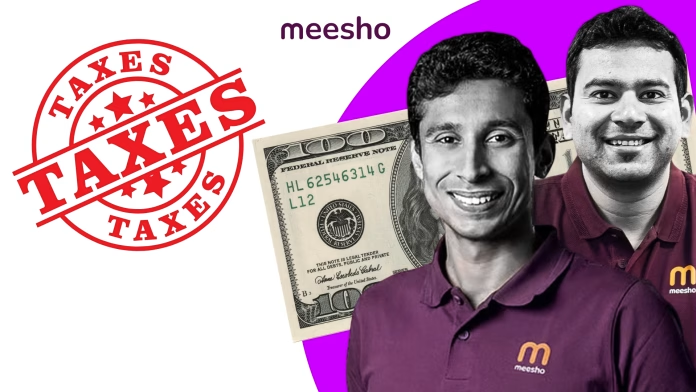
Meesho General Manager Megha Agarwal Resigns in First Senior Exit After IPO

0

Ecommerce marketplace Meesho has reported its first senior leadership change since its stock market debut, with Megha Agarwal stepping down from her role as General Manager – Business. The development was disclosed in a regulatory filing made on January 7.

Agarwal was part of Meesho’s senior management team and reported directly to founder and chief executive Vidit Aatrey. She joined the Bengaluru-based company in 2019 and played a key role in shaping its scale-up journey over the past five years. In 2022, she was elevated to lead Meesho’s growth function, overseeing initiatives aimed at expanding user acquisition and category depth. She took charge as General Manager – Business in 2023 following the exit of Utkrishta Kumar.

In her most recent role, Agarwal led category management across the marketplace and was closely involved in commercial strategy and seller expansion. Meesho confirmed in its exchange filing that she tendered her resignation on January 7, marking the first senior-level exit after the company’s public listing in December.

The announcement comes at a crucial phase for Meesho as it adjusts to heightened scrutiny as a listed entity. The company debuted on the exchanges on December 10 after raising ₹5,421 crore through its initial public offering. On the day of the disclosure, Meesho’s shares closed nearly 5 percent lower at ₹173.20 on the BSE.

Financially, Meesho has reported steady improvement in its operating performance. In the first half of FY26, operating revenue rose to ₹5,577 crore, compared with ₹4,311 crore in the same period last year. Net losses narrowed sharply to ₹700 crore from ₹2,512 crore year-on-year.

For the full FY25, Meesho posted a 23 percent increase in operating revenue to ₹9,390 crore. However, the company reported a net loss of ₹3,942 crore, largely due to a one-time tax expense linked to relocating its corporate domicile from the United States to India.

As Meesho focuses on profitability and execution discipline, leadership continuity will remain a key area of attention for investors and stakeholders alike.

Advertisement

D2C Beauty Brand AntiNorm Raises ₹28 Crore in Seed Funding Led by Fireside Ventures

0
Image of AntiNorm
D2C Beauty Brand AntiNorm Raises ₹28 Crore in Seed Funding Led by Fireside Ventures

New Delhi-based direct-to-consumer beauty brand AntiNorm has secured ₹28 crore in a seed funding round, signalling growing investor confidence in India’s emerging new-age beauty labels. The round was led by consumer-focused venture capital firm Fireside Ventures, with strong follow-on participation from existing backers V3 Ventures and Rukam Capital, both of whom increased their exposure to the company.

The funding marks a significant milestone for AntiNorm as it looks to scale beyond its early traction phase and build a differentiated presence in India’s increasingly competitive beauty and personal care market. Founded with a focus on challenging conventional beauty norms, the brand positions itself around ingredient transparency, performance-led formulations, and a modern consumer-first approach.

According to the company, the capital infusion will be channelled into three priority areas. A large portion will be invested in expanding distribution, with a dual focus on strengthening its digital channels while selectively entering offline retail to improve reach and visibility. AntiNorm plans to tap into premium retail formats and experiential touchpoints as part of its offline strategy, aimed at driving brand discovery and trust.

The brand will also step up investments in research and development, as it works to broaden its product portfolio and introduce formulations tailored to evolving consumer needs. Building in-house R&D capabilities and collaborating with formulation partners are expected to be key focus areas as the company looks to differentiate itself through product efficacy rather than marketing-led growth alone.

In parallel, AntiNorm intends to scale its direct-to-consumer operations by enhancing supply chain efficiency, improving customer experience, and strengthening its core team across marketing, technology, and operations. The company believes that tighter control over the D2C stack will be critical to sustaining margins while scaling volumes.

The fundraise comes at a time when India’s D2C beauty segment continues to attract capital, driven by rising disposable incomes, premiumisation, and a shift towards digital-first brand discovery. With Fireside Ventures backing its next phase of growth, AntiNorm is positioning itself to compete in a crowded but fast-expanding market where differentiation, execution, and consumer trust remain decisive.

Advertisement

&Done Raises $3 Million in Funding Led by RTP Global to Scale Science-Backed Haircare Brand

0

Gurugram based haircare startup &Done has raised $3 million in a fresh funding round led by global venture firm RTP Global, signalling continued investor interest in science backed beauty brands built for Indian consumers. The round also saw participation from All In Capital and Suashish, along with angel investors Kitty Agarwal of Info Edge Ventures and Titan Capital founders Kunal Bahl and Rohit Bansal.

Founded in 2023 by Atit Jain and Saumya Yadav, &Done began its journey as a professional haircare brand focused on salon use before entering the consumer retail segment last year. The company positions itself as a performance led brand, developing formulations designed specifically for Indian hair types while matching international quality benchmarks.

The newly raised capital will be deployed to strengthen the team, deepen research and development capabilities, expand the product portfolio and step up investments in brand building and marketing. Yadav said the brand aims to address a long standing gap in the market where consumers struggle to find solutions that deliver visible results. The founders believe trust, clinical formulation and professional validation will be key to winning long term loyalty.

&Done’s professional range is currently available across more than 500 salons in markets including Delhi NCR, Karnataka, Tamil Nadu, Uttar Pradesh and Hyderabad. The company follows an omnichannel strategy, selling through both digital platforms and offline channels. Over the coming year, it plans to widen its retail portfolio with problem focused products targeting concerns such as dandruff and scalp health.

Manufacturing is based in India, while select ingredients are sourced internationally to meet formulation standards. RTP Global said the brand’s salon first approach gives it a strong edge in an increasingly crowded beauty landscape and positions it to build a differentiated presence in professional haircare.

Prior to this round, &Done had raised Rs 3 crore. The funding comes amid a wave of investments into India focused hair and beauty brands, reflecting growing demand for specialised, results driven personal care products.

Advertisement

Prashant Peres Appointed GM, India as Mars Completes Kellanova Integration

0

Prashant Peres has assumed charge as General Manager, India for Mars Snacking, stepping into the role at a pivotal moment for the global food major following the integration of Kellanova into Mars’ snacking business.

The leadership transition comes weeks after Mars, Incorporated formally completed its acquisition of Kellanova on December 11, 2025, bringing together two of the world’s most recognisable snacking portfolios. For India, one of the fastest growing packaged food markets globally, the consolidation significantly expands Mars’ presence across confectionery, salty snacks, cereals and nutrition-led categories.

Peres takes responsibility for the combined India operations, overseeing brands such as Snickers, M&M’s, Twix, Dove and Skittles from Mars, alongside Pringles, Cheez-It, Pop-Tarts and Kellogg’s cereal and snacking brands from Kellanova. The integrated portfolio positions Mars Snacking as a multi-category player spanning indulgence, breakfast and on-the-go consumption.

A seasoned FMCG leader with more than two decades of experience, Peres most recently served as Managing Director for South Asia at Kellanova. Earlier, he held senior roles at Kellogg Company, where he led the cereals and snacks business through a phase of restructuring and market repositioning. Prior to that, he spent over eight years at Mondelēz International, including leading the Cadbury chocolates business in India during a period of record growth, and later heading operations in Indonesia.

Peres began his career at Unilever, where he held leadership positions across foods, soaps and personal care portfolios in South Asia, Africa and the Middle East.

Mars has said the Kellanova acquisition strengthens its ambition to shape the future of snacking by combining scale, innovation and category depth. Globally, Mars Snacking now employs more than 50,000 people and manages several billion-dollar brands.

In India, the combined business is expected to sharpen its focus on urban consumption, premiumisation and expanding modern trade and digital channels, while navigating price sensitivity and evolving consumer preferences. The coming phase will test how effectively the global integration translates into local growth execution in a highly competitive market.

Advertisement

Zepto Introduces In-App UPI Payments to Speed Up Checkout and Cut Payment Failures

0

Quick commerce major Zepto has quietly introduced an in app UPI payment option, marking a significant step in how delivery platforms are reworking their checkout experience. The feature has been live for nearly six months, according to people familiar with the development, and allows customers to complete UPI payments within the Zepto app without being redirected to third party applications such as Google Pay or PhonePe.

The rollout reflects a wider industry shift, with large consumer internet platforms increasingly choosing to internalise payments as they chase faster checkouts and higher transaction success rates. Zepto has not made a formal announcement on the launch and did not respond to questions on the backend structure of the offering at the time of publication.

By adding in app UPI, Zepto joins food delivery peers Swiggy and Zomato, both of which have built proprietary UPI flows over the past year. Swiggy introduced Swiggy UPI using NPCI’s UPI plug in framework, enabling users to pay within the app after a one time setup. The company has said the move helps reduce checkout time and lowers payment failures caused by app switching.

Zomato has taken a slightly different route, launching its own UPI service in partnership with ICICI Bank. The feature allows users to generate a Zomato linked UPI ID and complete real time payments directly inside the app, giving the platform deeper control over the payment experience.

Industry executives say payments have become a key lever for delivery platforms operating at scale. Even small gains in transaction speed or success rates can translate into meaningful improvements in order completion, especially during peak demand windows. Bringing payments in house also reduces dependence on external apps and gives platforms better visibility into transaction flows.

For Zepto, which has been expanding its dark store footprint and processing a rising volume of high frequency orders, tightening the checkout layer fits into its broader focus on speed and reliability. The move highlights how payments are no longer just an infrastructure layer but a strategic priority as competition in food delivery and quick commerce intensifies.

Advertisement

No Tip, Just Respect Why Swiggy Delivery Partner Ajay’s Simple Request Struck a Chord Online

0

What began as a routine Instamart delivery quickly turned into a moment that struck a chord with thousands online. A Swiggy delivery partner arrived with his young child seated quietly on the bike behind him, delivered the order, and then surprised the customer by politely refusing a tip. Instead, he asked for something far simpler and far more meaningful to him: a good rating.

The incident was shared on X by user Vineeth K, who posted that the delivery partner had come to deliver Instamart items. When Vineeth noticed the child and asked about him, the man calmly replied that it was his son. A photo shared along with the post showed the young boy sitting patiently on the bike, bundled up and waiting as his father completed the delivery.

Vineeth explained that he usually tips delivery workers directly in cash. This time, when he offered money, the delivery partner, identified as Ajay, refused without hesitation. According to the post, Ajay simply said that a positive rating would help him more. There was no complaint, no explanation, and no attempt to seek sympathy.

The post quickly gained traction, with many users praising Ajay’s honesty and work ethic. Several comments pointed out how ratings play a crucial role in determining delivery partners’ incentives, shifts, and future orders. One user wrote that most delivery workers rarely expect tips and instead focus on maintaining strong ratings to protect their livelihood.

HT.com has reached out to the original poster for additional details, and the report may be updated if more information emerges.

In a time when social media is filled with outrage and noise, this small interaction stood out for its quiet dignity. It highlighted the daily realities faced by gig workers and reminded many that respect, acknowledgment, and fairness often matter more than spare change. Sometimes, a simple five star rating carries far more weight than a folded note.

Advertisement

Blue Tokai FY25: Net Loss Narrows 20% to ₹50 Cr as Revenue Crosses ₹325 Cr

0

Speciality coffee chain Blue Tokai Coffee Roasters reported a sharper focus on financial discipline in FY25 as its net loss narrowed by over 20 percent, even while the company continued to scale its retail and roasting footprint across India and overseas.

For the year ended March 2025, Blue Tokai posted a net loss of ₹50.2 crore, compared to ₹62.9 crore in FY24. The improvement was driven by stronger operating performance, though the bottom line remained under pressure due to a higher tax outgo of ₹11.1 crore during the year, against a tax gain of more than ₹1 crore in the previous fiscal. Loss before tax declined nearly 40 percent to ₹39.1 crore from ₹64.2 crore a year earlier.

Revenue growth remained robust. Operating income rose 1.5 times year-on-year to ₹325.4 crore in FY25 from ₹215.8 crore in FY24, reflecting steady demand across cafés, packaged coffee sales and institutional channels. Including other income of ₹7.3 crore, total income stood at ₹221.1 crore, marking a year-on-year increase of just over 50 percent.

Founded in 2013, Blue Tokai has steadily expanded its presence in India’s premium coffee market. The company currently operates four roasting facilities and more than 100 outlets across major cities including Delhi NCR, Mumbai, Bengaluru and Hyderabad. Internationally, it has established operations in Tokyo and Dubai, signalling ambitions beyond the domestic market.

The company’s expansion strategy, however, came with higher costs. Total expenditure increased 35.3 percent to ₹385 crore in FY25 from ₹284.5 crore in the previous year, driven by store additions, supply chain investments and rising operating overheads.

Blue Tokai competes in a crowded speciality coffee segment alongside players such as Third Wave Coffee Roasters, SLAY Coffee, Rage Coffee and Sleepy Owl. Since inception, the brand has raised over $97 million from investors including Verlinvest, A91 Partners, Anicut Capital and 12 Flags.

While losses persist, the narrowing gap between revenue growth and cash burn suggests a gradual move toward a more sustainable operating model as India’s café culture continues to evolve.

Advertisement

Federal Bank Brings Vidya Balan Onboard for New Look Gallery in a Move to Strengthen Customer Connect at Scale

0

Federal Bank has introduced a refreshed chapter in its brand journey with actor Vidya Balan stepping in as its brand ambassador for the unveiling of the bank’s new look gallery. The collaboration signals a clear intent to blend legacy banking values with a modern, customer first identity.

Vidya Balan’s association with Federal Bank comes at a time when the institution is sharpening its focus on trust, inclusivity and everyday relevance. Known for her grounded public persona and strong screen presence, Balan reflects qualities that the bank has consistently stood for across its decades long presence in Indian banking. Her role goes beyond celebrity appeal and aims to strengthen emotional connect with customers across age groups.

The new look gallery represents Federal Bank’s evolving visual and experiential language. From redesigned branch interiors to updated branding elements, the initiative is part of a larger effort to make banking feel more accessible and intuitive. The bank currently operates over 1,300 branches and serves millions of customers across India, making this refresh a significant milestone in its growth story.

Speaking through this partnership, Federal Bank underlines its belief that banking today is not just about transactions but about relationships built on confidence and clarity. Vidya Balan’s presence at the unveiling added warmth and familiarity to the occasion, reinforcing the message of reliability with a contemporary touch.

As competition intensifies in the financial services space, Federal Bank’s move highlights how traditional institutions are rethinking brand engagement. By pairing a refreshed visual identity with a trusted face, the bank aims to stay relevant in a rapidly changing market while holding on to the values that have defined it for generations.

Advertisement

Zomato CEO Deepinder Goyal Warns of AI Driven Refund Fraud Costing Food Delivery Platforms Crores Every Year

0

Zomato CEO Deepinder Goyal has raised a serious red flag about a growing problem quietly eating into the margins of food delivery platforms: refund fraud powered by artificial intelligence. According to Goyal, customers are increasingly using AI tools to doctor images of food orders, making perfectly fine meals appear damaged, contaminated, or mishandled.

The most common tricks include digitally added insects, cracked containers, spilled gravies, and even smashed birthday cakes. These edited images are then submitted as proof to claim refunds or replacements. What makes the issue harder to tackle is how realistic these AI generated images have become, often passing basic visual checks with ease.

Industry insiders say refund abuse has always existed, but the scale has changed dramatically over the past year. With generative AI tools becoming cheap and accessible, even first time users can manipulate photos in minutes. For platforms like Zomato, Swiggy, and others, this has translated into higher losses and increased pressure on restaurant partners who are often penalized for issues that never occurred.

Goyal pointed out that such misuse forces companies to rethink trust based systems. Refunds that were once processed quickly are now being subjected to tighter verification, longer resolution times, and advanced fraud detection models. While this protects businesses, it also risks frustrating genuine customers with real complaints.

E commerce players are now investing heavily in image forensics, metadata checks, and behavioral analysis to separate real issues from manufactured ones. Some platforms are also quietly tracking repeat refund patterns to flag suspicious accounts.

The episode highlights an uncomfortable reality. As AI tools become more powerful, they are not just improving productivity but also creating new avenues for everyday fraud. For consumer tech companies, the challenge is no longer just growth, but defending trust in an era where seeing is no longer believing.

Advertisement

Locked Out at 3 AM in Pune How Mihir Gahukar and Friends Turned to a Blinkit Delivery Agent for a Midnight Rescue

0

A late night situation in Pune has taken the internet by surprise after a group of friends found themselves locked out on their own balcony at 3 am. With no way to enter the house and everyone inside asleep, the group turned to an unexpected source for help: a Blinkit delivery agent.

The incident was shared on Instagram by Mihir Gahukar, whose video quickly went viral. In the clip, one of the friends is seen calmly speaking to a Blinkit delivery partner on the phone, explaining that they were stranded outside while the parents of one of them slept inside the locked house. Ringing the bell and calling out had failed, and the night kept getting colder.

With limited options left, the group requested the delivery agent to come over and help wake the family. The Blinkit agent arrived, knocked on the door repeatedly, and managed to alert the parents, eventually helping the friends get back inside safely.

What made the video resonate was its mix of panic, calm thinking, and an oddly wholesome outcome. Viewers flooded the comments with jokes and personal stories. One user joked about how awkward it would be for parents to wake up and see a delivery agent inside their home. Another praised the agent for removing his shoes before entering, calling it a small but respectful gesture.

Blinkit also joined the conversation, commenting that such things could only happen in Pune, which added to the humour around the situation.

Beyond the laughs, the incident highlighted how delivery workers often go beyond their job descriptions in real life situations. What started as a stressful moment turned into a reminder of human kindness, presence of mind, and how modern city life can throw up the most unexpected solutions at the strangest hours.

Advertisement