Allied Blenders and Distillers (ABD) is a leading player in the Indian spirits industry, with a focus on the whisky segment. Founded in 1989, ABD has become the largest whisky producer in India and the world’s third-most-popular whisky producer, with brands such as Officer’s Choice and Sterling Reserve that are popular among Indian consumers. The company has a robust distribution network in India and exports its products to over 20 countries worldwide.
In recent years, India has emerged as a major player in the global whisky industry, with the country currently producing 60% of the world’s whisky. India’s whisky is primarily made from molasses, grain, and malt, and has a distinct flavor profile that sets it apart from other whiskies produced around the world. As a result, Indian whiskies have gained popularity among consumers in several countries, including the United States, the United Kingdom, and South Africa.
ABD’s decision to enter the Russian market is significant, given that Russia is a large consumer of alcoholic beverages, including whisky. However, the market for imported whisky in Russia has been affected by trade restrictions imposed by some Western countries, leading to a scarcity of the spirit. ABD aims to capitalize on this opportunity by replacing the Western brands that have stopped delivering to the country and capturing the market share they have vacated.
ABD’s partnership with Alcohol Siberia Group (ASG), a leading vodka manufacturer in Russia, is expected to help the company navigate the local market and establish a foothold in the country. ASG’s expertise in the Russian market, combined with ABD’s expertise in whisky production, is likely to be a winning combination for both companies.
The pricing strategy adopted by ABD for its products in the Russian market is also noteworthy. The company plans to price its Officer’s Choice Blue whisky and Sterling Reserve premium blend at competitive rates, which is likely to appeal to Russian consumers who have been facing a shortage of affordable imported whisky in recent times.
ABD’s entry into the Russian market marks a significant milestone for the company and the Indian whisky industry as a whole. It is an opportunity for ABD to expand its business, tap into a new market, and potentially cement India’s position as a major player in the global whisky industry. With its expertise in whisky production and the support of its partner, ASG, ABD is well-positioned to succeed in the Russian market and beyond.
McDonald’s India – North and East is committed to making a positive impact in the local communities it serves. The company recognizes that there are many individuals who lack access to education, training, and employment opportunities, especially those who come from disadvantaged backgrounds. As such, McDonald’s India – North and East has launched the ‘McDonald’s For Youth’ community campaign to help create meaningful employment prospects for local communities, with a particular focus on the less privileged.
Through this initiative, McDonald’s India – North and East has pledged to hire 1500 people through non-governmental organizations by 2025, representing 50% of its workforce. The company has already hired over 500 young people in the last year, partnering with several reputed not-for-profit organizations such as Magic Bus, Tech Mahindra Foundation, Quess Corp Foundation, and Tarraqi, amongst others.
Rajeev Ranjan, Managing Director, McDonald’s India – North and East, said,”‘McDonalds for Youth’ is a campaign through which we aim to offer gainful employment for the youth, especially youth from the under-privileged communities who have limited education and employment opportunities. We aim to hire 50 percent of our entry level workforce under this initiative, invest in their overall growth and development through our world class high-quality training and learning programmes. This initiative is much more than filling open positions – it is about being a part of the local communities, and is an attempt to make them a part of us. We invite more organisations to join us in our endeavour to dismantle the barriers to equal opportunities, dismantle barriers to economic growth and empower the youth to excel in their work and life.”
For most people hired through the ‘McDonald’s For Youth’ campaign, this will be their first job. The opportunity to work at McDonald’s represents an important milestone in their lives, as it provides them with a source of income and valuable training opportunities.
McDonald’s global training curriculum is designed to equip young people with the skills and knowledge they need to succeed in their careers. This includes skills such as food safety and hygiene practices, safe food handling, customer service, communication, and teamwork. Through its robust training programs, McDonald’s has a proud legacy of shaping hospitality professionals, instilling the right attitude, empathy, and passion in people.
By providing employment opportunities through NGOs, McDonald’s India – North and East hopes to create a ripple effect that extends far beyond the walls of its restaurants. The company believes that providing equal opportunities and a better future for all is one of the most pressing issues facing our world today.
Through its collaboration with NGOs, McDonald’s India – North and East aims to be a catalyst for change, shaping a brighter future for India. The company recognizes that positive change is not limited to the impact it can have on individuals’ lives, but can also create positive change in the communities it serves, driving economic growth and prosperity.
Twisting Scoops, an Indian ice cream brand, was founded with the vision of bringing the unique flavors and textures of Turkish ice cream to India. The brand has gained popularity for its innovative and twisted ice cream creations, which incorporate traditional Turkish desserts and flavors into its menu.
Recently, Twisting Scoops opened its second outlet in Mumbai at the Viviana Mall, making it the brand’s 45th outlet in India. This new outlet launch comes after the brand’s successful appearance on season 2 of Shark Tank India, which helped to create greater awareness and demand for the brand.
Simranjeet Singh, Director, CYK Hospitalities, said, “We researched the location and mapped where Twisting Scoops could better reach their customers. So, our team of experts analyzed and located out the best location and helped them with the best leasing deals. Not only with the location, we have also tried our level best to curate the most innovative menu in the ice cream space”.
Kunwarpreet Singh Juneja, MD, Twisting Scoops, said, “CYK Hospitalities has played an integral part when it comes to Twisting Scoops expansion. They are our trusted partners whenever we are selecting any location for our upcoming store. CYK team’s due diligence has always helped us in getting the ROI of the store beforehand. In fact, the operations team of the company has always stood by us whenever we are revamping our menu and need their expert guidance.”
To support the brand’s rapid expansion both in India and internationally, Twisting Scoops has partnered with CYK Hospitalities, an F&B consultancy firm. CYK Hospitalities provides a range of services to Twisting Scoops, including location mapping, leasing, and menu curation for its outlets across malls, highways, airports, and other venues both in India and globally.
The new outlet in Viviana Mall in Mumbai is the second outlet for the brand in the city, with the first being located at Jio World Drive. Twisting Scoops has also announced that it will be opening its next outlet at the newly opened Phoenix Palladium Mall in Ahmedabad soon.
Twisting Scoops already has a significant presence in four countries, including India, Sri Lanka, USA, and Bangladesh, with over 45 outlets. The brand’s menu includes more than 25 unique flavors such as Turkish Baklava, Turkish Desserts, Kunafa, and Turkish Coffee/beverages. CYK Hospitalities helps the brand to customize and curate its menu based on the local climate and tastes of the region to cater to the local population.
Twisting Scoops is a rapidly growing ice cream brand in India that has captured the attention of consumers with its innovative and unique ice cream creations. With its continued expansion and partnership with CYK Hospitalities, the brand is well-positioned to continue its growth both in India and globally.
Swiggy, a popular food and grocery delivery company based in India, has been taking measures to cut costs and streamline its operations. One such measure involved the recent sale of its cloud kitchen business, Swiggy Access, to Kitchens@, a brand owned by Loyal Hospitality.
Swiggy Access provided kitchen spaces to restaurants both online and offline, allowing them to expand their reach and ensure faster delivery to customers. This acquisition has resulted in Swiggy becoming a stakeholder in Kitchens@.
According to Kitchens@, the combined gross merchandise value (GMV) of the two companies is expected to be around $65 million, with plans to increase it to $100 million within the next six months. This acquisition is part of Swiggy’s wider cost-cutting measures due to slow growth in its food delivery business and a funding crunch caused by macroeconomic factors.
Junaiz Kizhakkayil, CEO of Kitchens@. Said “The addition of Swiggy’s Access kitchens will bolster the reach and operations of Kitchens@’s in four cities across 52 locations and 700+ kitchens, providing customers with more convenient and efficient food delivery options.”
Rahul Bothra, Chief Financial Officer of Swiggy, said “Swiggy Access was started with the aim to bridge hyperlocal gaps in restaurant supply and solve for variety, quality, and convenience of food. Since its inception, Access has enabled several restaurant partners to innovate and expand their reach to new customers in a cost-effective manner.” and added “We are confident that Kitchens@ is fully equipped to nurture this ecosystem by innovating and building more supply. Swiggy continues to believe in the potential of this space and remains invested as a stakeholder in Kitchens@.”
As part of its cost-cutting efforts, Swiggy recently tightened its password-sharing policy for Swiggy One users, a loyalty program that offers free deliveries and other benefits to its customers. This change limits multiple logins to two devices, helping to prevent users from sharing their login credentials with others.
Swiggy has also recently launched several new units to expand its offerings. Handpicked is a premium grocery delivery service, Minis is a direct-to-commerce ecommerce marketplace, and DineOut is a restaurant table reservation service. These new units demonstrate Swiggy’s commitment to innovation and expanding its business beyond just food delivery.
Swiggy’s recent actions highlight the challenges faced by food delivery companies in a competitive market. While the company is taking measures to streamline its operations and cut costs, it is also actively seeking new opportunities to grow and diversify its offerings.
Bagrry’s India is a well-known and highly respected brand in the breakfast cereals and health food category. It is a leading player in this industry, offering a wide range of healthy and nutritious products that are designed to meet the needs of modern consumers who are increasingly health-conscious.
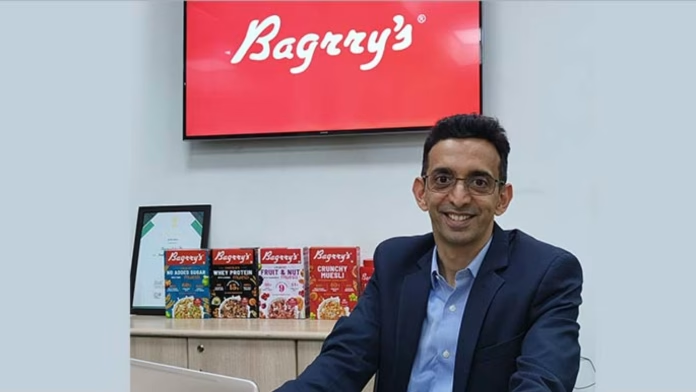
To further strengthen its position in the market and take advantage of the numerous opportunities available, Bagrry’s India recently announced the appointment of Jayant Kapre as its new Managing Director and Chief Executive Officer. This move is expected to help the company accelerate its growth trajectory and achieve even greater success in the years ahead.
Jayant Kapre, MD & CEO of Bagrry’s India, said, “It is rare to find a food company that matches the attention to nutrition, quality and hygiene at Bagrry’s. Working on trustworthy recipes which are truly good for consumers was a great draw for me- the world needs more of this right now!”
and added “The business has been extremely well run so far and the profitable growth is testimony to this. The brand is at an exciting crossroads in its journey, and I am glad to lead a vital change in momentum. I seek to fuel growth and expansion across categories, whilst maintaining profitability.”
Aditya Bagri, Director, Bagrry’s Group, said, “At Bagrry’s, with a lineage of over 50 years of innovation, we’re building India’s most trusted health food brand. Our vision has always been to transform our family business into an institution driven by some of the finest consumer minds.”
He further said, “Jayant brings with him decades of unparalleled leadership experience in the FMCG & food processing space, and also resonates with our core values. We’re excited to have him on board and we are confident that he’ll scale Bagrry’s to newer heights.”
As Managing Director and CEO, Kapre will be responsible for developing and executing a comprehensive growth strategy for Bagrry’s India. This will involve identifying new business opportunities, enhancing the company’s product portfolio, and expanding its reach into new markets. He will also be tasked with enhancing the brand’s commercial advantage and driving growth across all key areas of the business.
Kapre is a highly experienced professional with over 26 years of experience in the FMCG sector, with a particular focus on the food industry. He has held several key leadership positions at some of the industry’s most prominent companies, including Wrigley, Frito Lay, McVitie’s, and Britannia. Throughout his career, he has developed a reputation as a results-driven leader with a strong track record of success.
With Kapre at the helm, Bagrry’s India is well-positioned to continue its impressive growth trajectory and cement its status as a top player in the breakfast cereals and health food category. By leveraging Kapre’s experience and expertise, the company can drive innovation, expand its product range, and deliver even greater value to its customers.
One of the most underrated things in this world is colors. The very idea of a monochrome world sounds kinda depressing. Just like our external world, humans from inside are shades of different colors and it doesn’t get celebrated enough, unless it is the time of Holi in India, where we not only celebrate colors and paint each other but also celebrate coming together, dancing to the beat of dhols, snacking like there is no tomorrow and simply letting a different shade of color come out.
Bhaang and Holi have become synonymous with happiness, joy, and celebration in India. Food in holi becomes not only a way of celebration but also an expression of the festival itself.
Bhelpuri is one snack that reminds me of colors, as the snack has multiple colors in the palette just like the world gets when we play Holi. That makes Bhelpuri the perfect snack for Holi, and when paired with Bhaang it is like having the best of both world at the same time.
The bright red of the diced tomatoes, vibrant green of the cilantro, yellow of the sev, and the orange-brown hue of the tamarind chutney all come together to create a feast for the eyes. And that’s not even counting the other colorful ingredients that can be added to bhel, such as green chilies, red onions, or even purple cabbage!
it’s not just the colors that make bhelpuri a treat for the senses.
The combination of textures, from the crunchy sev to the soft potatoes, the juicy tomatoes to the crispy papdi, makes every bite a delight. Then there’s the explosion of flavors that hits your taste buds, from the sourness of the tamarind chutney to the spiciness of the green chilies, the sweetness of the diced onions to the tanginess of the lemon juice.
There is so much going on at the same time in this easy-to-make and light snack that it feels unrealistic especially when paired with Bhaang it makes it like an edible cocktail which is like pure bliss for anyone who consumes it.
So, do me a favor and lets play holi by creating this Bhaang ki bhel in these super easy steps, mentioned below :
Ingredients:
2 cups puffed rice (murmura)
1/4 cup bhaang (cannabis) leaves, finely chopped
1/2 cup onion, finely chopped
1/2 cup tomato, finely chopped
1/2 cup boiled potatoes, finely chopped
1/4 cup raw mango, finely chopped
1 green chili, finely chopped
1/4 cup roasted peanuts
1/4 cup sev
2 tablespoons tamarind chutney
1 tablespoon lemon juice
Salt to taste
Instructions:
In a mixing bowl, add puffed rice, chopped bhaang leaves, onion, tomato, boiled potatoes, raw mango, and green chili. Mix everything well.
Add roasted peanuts and sev to the mixture.
Add tamarind chutney, lemon juice, and salt. Mix everything well.
Serve immediately and enjoy your delicious bhaang ki bhel!
Note: You can adjust the quantity of tamarind chutney and lemon juice as per your taste. Also, feel free to add any other ingredients of your choice to the bhel. Have fun experimenting!
Starting and managing a food business can be challenging, especially when it comes to generating consistent revenue. With so much competition in the food industry, it can be difficult to stand out and attract customers.
Covid has been an inflection point which gave a never-anticipated impetus to the food and beverage industry, globally. The growth that brands would have experienced in a decade is pushed to improve and incorporate efficiency in their operating methods, today. To add to this complexity changing dynamics of consumer preferences and constant influence have added a deeper layer of expectation from the brands.
Consumer influence is a significant driver of change in the food industry. In recent years, consumers have become more health conscious and environmentally aware, and their expectations from food businesses have shifted accordingly. They are looking for healthier options on restaurant menus, and they want to know what ingredients are being used in their food. As a result, food businesses are expected to offer healthier menu options, use natural and organic ingredients, and provide more information about their food’s nutritional value.
Another key aspect that has become critical in the post-covid world is environmental sustainability, a top concern for aware, agile consumers. They are looking for businesses that use sustainable practices, reduce food waste, and minimize their carbon footprint. Food businesses are expected to source ingredients from local farmers, reduce packaging waste, and implement environmentally-friendly practices in their operations.
Consumers today are also looking for authenticity and transparency in the food they consume. Traceability in the food industry is a massive opportunity, as consumers want to know where their food comes from, how it’s prepared, and what ingredients are being used.
Food businesses are expected to be transparent about their sourcing, cooking methods, and ingredient lists. With all of these issues, one of the key aspects that have taken shape is the consumers’ expectation for personalized experiences when it comes to food. They want menu options that cater to their dietary restrictions and preferences, and they want to be able to customize their orders. Food businesses are expected to offer more options and flexibility in their menus to cater to these personalized preferences.
In this new market, which is young, aware and experimentative, with the right strategies in place, consumer-facing food businesses, which includes Restaurants, Cloud kitchens, and D2C brands and can significantly increase your revenue, can create an indelible impression and grow their food brands across markets.
Here are some key steps that food businesses should undertake to improve their revenues. These hacks are based on proven strategies that successful food businesses are using to increase their revenue.
Understand what’s trending !! Introduce new menu items regularly
One of the best ways to increase revenue in a food business is by introducing new menu items. By adding new dishes to your menu, you can attract customers who are looking for something different or exciting.
Additionally, introducing new menu items can increase the variety of food you offer and make your restaurant or cafe a go-to spot for a wider range of customers. That said, all new introductions should be designed to leverage the existing supply chain and production infrastructure. To introduce new menu items, brands must conduct local market research to identify customer preferences and variations in choices for a fortnight.
One can use social media platforms to test the waters and map responses, online surveys, or in-person questionnaires to gather information on what your customers like and dislike are good ways to decode shifts in tastes and preferences. Based on this information, create new menu items that align with customer preferences.
When introducing new menu items, it’s important to promote them through various marketing channels. You can use social media platforms, email marketing, or in-store promotions to advertise new menu items. By promoting new menu items, you can create buzz and generate excitement among your customers.
2. B2B should be a critical part of the strategy
In an evolving consumer market, businesses with deep cash reserves and war chests tend to be more agile and prepared better to tackle competition with speed. While restaurants and cloud kitchens should offer catering services leveraging their existing infra, catering services provide an additional revenue stream and can bring in the required buffer to experiment in the consumer business.
By offering catering services, you can reach a wider audience and generate more revenue. Catering services can be used for a variety of events, including weddings, corporate events, and parties.
To offer catering services, start by creating a catering menu that includes a variety of dishes that can be easily transported and served at events. You can then promote your catering services through your website, social media, and other marketing channels. When offering catering services, it’s important to provide excellent customer service and ensure that the food is of high quality. Word-of-mouth marketing can be powerful for catering services, and providing exceptional service can lead to repeat business and referrals.
3. Don’t limit your existence to Instagram !!! Improve Social & online presence
In today’s digital age, having a strong online presence is essential for any food business. By increasing your online presence, you can reach a wider audience and generate more revenue. To increase your online presence, start by optimizing your website for search engines. This includes using relevant keywords, creating high-quality content, and ensuring that your website is mobile-friendly.
You can also use social media platforms to engage with your customers and promote your business. This includes creating a social media strategy, posting regularly, and engaging with your followers. Another way to increase your online presence is by partnering with food bloggers and influencers. Instead of doing a paid activity with them, try and negotiate a reseller model where they are incentivised on campaign-generated sales. This will help increase your reach and generate buzz about your business and keep costs in check.
Apart from partnering with bloggers and influencers, start by identifying and looking for credible media platforms that endorse your product and help you with an amazing reputation. Collaboration in the food businesses is the key to long-term recall and communicating with various permutations and combinations with consumers.
4. Decrease Customer Acquisition Cost !!! Implement loyalty programs. Incentivise the consumer for every purchase.
Loyalty programs can be an effective way to increase revenue in a food business. By rewarding your loyal customers, you can encourage them to come back and increase their spending on each visit.
Additionally, loyalty programs can help increase customer retention and generate repeat business. To implement a loyalty program, start by creating a rewards system that is easy to understand and offers tangible benefits to your customers. This can include discounts, free meals or drinks, or other incentives.
You can then promote your loyalty program through your website, social media, and other marketing channels. When implementing a loyalty program, it’s important to track the results and adjust the program as needed. This includes monitoring the redemption rate and adjusting the rewards system to ensure that it is effective in increasing revenue.
5. Focus on upselling and cross-selling
Traditionally brands undertake Upselling and cross-selling within their product range. That usually is dependent upon consumers returning for a hero product from the brand. This strategy can be limiting as the consumer is in a very dynamic market setting.
Today brands need to leverage the aligned ecosystem of other brands that can offer their products as an add-on to their customer. This de-risks brands and helps them achieve more consumer engagement and future recall. It can be an effective way to increase revenue in a food business.
By offering additional products or services, you can increase the value of each customer transaction. To upsell, offer customers a larger portion size, an extra side dish or a more expensive menu item. To cross-sell, recommend complementary items that can be added to their order, such as a drink or a dessert.
6. Offer direct online ordering and delivery with a pay-later option
In recent years, online ordering and delivery have become increasingly popular in the food industry. Offering direct online ordering and delivery can save you upwards of 25% and helps the brand build a direct relationship with the brand.
To offer direct online ordering and delivery, brands can partner with third-party platforms which provide pre-designed platforms that can be customised as per the requirements of the brand. Some of the logistics players are offering a solution for standalone brands that help them run independent operations and fulfil their orders directly.
7. Create your IPR events !!! Host events and promotions
Creating IPR is a great way to engage customers and improve your brand value with customers. Hosting events and promotions can be a great way to attract new customers and generate buzz about your business.
While some of the larger brands offer such experiences, all brands must try and undertake such activities even if it is hosting small initiatives like a live music night, a trivia night or a themed event. You can also offer promotions, loyalty benefits programs, bonuses or holiday specials.
Some of the elements that have to be key to any food business are the mechanics to engage the customer by providing exceptional customer service. It is a powerful way to generate repeat business and positive word-of-mouth marketing.
Make sure your staff is well-trained, friendly and attentive to customers’ needs. Respond to customer feedback and address any concerns promptly and professionally. Finally, implementing cost-saving measures can help you increase your revenue by improving your profit margins. This can include reducing food waste, optimizing inventory management, and negotiating better prices with suppliers. By reducing costs, you can improve your bottom line and increase your revenue.
Given the inquisitive nature of Indian minds, doing a food business has crossed everyone’s mind, many times. One thing which is most common among all of us is to calculate the earning of each food stall we ever eat at. The footfall only increases the aspiration to start one of our own.
For many, opening up a restaurant or some kind of food business has also been a retirement plan, until Covid hit. Covid has been the two most difficult years of mankind, it resurrected the thought in each one, of quitting their respective jobs and starting a food business.
While people are excited about the idea of starting up, they usually do not have the required capital for a startup. To crack that problem we have listed some of the businesses where genuinely passionate people can start sitting at home with zero investment. Food businesses can be a lucrative and rewarding venture, which one can start from the kitchen of their home, without any upfront investment.
With the rise of the gig economy and the rise of a savvy consumer with high disposable capital, it’s now possible to start a food business in minutes and earn thousands. Consumers today are far more connected and have the mind space and disposable incomes to experience new emerging brands.
We have encapsulated possible areas of food businesses people can explore sitting at home with zero capital.
Don’t to a typical catering business, Create a frontend Digital brand
One of the easiest food businesses you can start from home is a digital catering business where you do not need any resources apart from creating your digital identity. With a backend partner, a digital catering business is like a breeze. Unlike a traditional catering business which involves preparing and delivering meals for events, parties, and other gatherings, here you just have to be active on social media avenues like Instagram, Facebook linkedin etc.
All you need is to learn creative tools like Canva to communicate consistently with your customers. You can start this digital catering business with zero capital by utilizing your home cook and existing cooking equipment and ingredients in your home kitchen, or a local small-time restaurant in your vicinity.
You can also create a simple website or social media page to advertise your catering services and attract customers.
2. Have an Air Fryer? Start your Baking Business in 5 min
Another food business you can start sitting at home with zero capital is a baking business !! all you need is an Air Fryer. If you have a passion for baking and a reasonably equipped kitchen, you can create a range of cakes, breads, cookies, and other desserts to sell to customers.
You can start by offering your baked goods to friends and family, then expand to a wider customer base by creating a social media page or selling your products on Whatsapp, and online marketplaces like zomato & swiggy.
Many women entrepreneurs across emerging areas have built phenomenal brands with a massive following. It’s amazing to see how they have used their creativity to start some of these businesses, where everyone in the family is now involved and earnings are far higher than they had with their limited jobs.
3. Health-focused Meal Prep Delivery Service
If you are a fitness enthusiast, this is a food business that’s possibly the easiest for you to start. A healthy meal prep delivery service involves preparing and delivering healthy meals to customers’ doorsteps. The best part about this business is the subscription-based model of engagement with the consumers as they value a good nutritious meal. With more people looking for healthy meal options, this type of business can be highly in demand and scaled very fast.
You can start a meal prep delivery service from home with zero capital by utilizing your existing cooking equipment and ingredients. Some of the people who are in this trade have started with the first few customers on WhatsApp. If this is your calling, it’s simple to start by curating a menu, if you do not have one, or extending the health menu that you practice.
4. If you are a Pro, this one is for you: Personal Chef & Event Producer
This is an option where your imagination gets you serious monies !!! If you have a passion for cooking, a good understanding of wines or alcohol, and enjoy working one-on-one with clients, you can start a personal chef service from home. A personal chef service involves offering personalized cooking services to individuals or families for parties in their homes or offices.
5. Leveraging the rich Recipe of Nani’s & Dadi’s with Homemade Organic Food Products
If you have a rich repository of special recipes from your mother and grandmother and enjoy creating your food products, you can start a homemade food products business from home. This can include making and selling organic homemade jams, pickles, or sauces. You can start a homemade food products business with zero capital but need a backend to produce batches and logistics for shipments.
One such business which has achieved massive success is Jhaji StooreOnline Pickles. You can visit their website at https://www.jhajistore.com/. You can also watch the full interview of our interaction with the founder Mrs Kalpana Jha in the link below.
6. Global Specialty Food Items
If you are a specialist in a particular type of food, such as Japanese, Korean, Lebanese’s or vegan, gluten-free, or keto-friendly this is a business for you. This can be a great way to differentiate yourself from competitors and attract a niche customer base. You can start a speciality food items business with zero capital by utilizing your existing cooking equipment and ingredients.
While Instagram is a great way to promote your business, it is equally important for the founder of such a business to be visible across all key forums and evangelize the cause for such products and services.
7. Online Cooking Classes for New Mothers.
If you enjoy cooking and teaching and are keen to share your culinary skills with others, you can start an online cooking class business from home with a simple laptop. You can offer cooking classes to people who want to learn new culinary skills.
All it takes is setting up a simple Youtube channel, and putting your recipes out there for people to watch and learn from it. Managing a Youtube channel can be slightly tricky but many videos will help you to optimise your video for SEO and discovery.
8. Food Insta Jockey
If you are a video junkie, food blogging is the easiest option for you to undertake. This involves creating a blog or social media page to share your recipes, cooking tips, and food reviews with your audience. You can start a food blog with zero capital by simply creating a channel on Youtube, Instagram, TikTok and many others and grow your audience.
Once you have established a following, you can monetize your blog through sponsored content, affiliate marketing, or selling other services. One of the key underlying requirements of this business is an extremely good understanding of food and creative sensibilities to produce the best quality videos.
These businesses can open the doors of Entrepreneurship in the Food Industry, while you sit home with Zero Capital.
“There is only one boss: the customer. And he can fire everybody in the company, from the chairman on down, simply by spending his money somewhere else.” – Sam Walton, founder of Walmart.
This quote highlights the importance of understanding and catering to your target market, as they ultimately hold the power to determine the success or failure of your business. By putting the customer at the centre of your business strategy, you can create products and services that meet their needs and build strong, long-lasting relationships with your target market.
As an entrepreneur, it’s essential to know who your target market is. Your target market represents the group of people who are most likely to be interested in your product or service. By identifying your target market, you can create effective marketing campaigns, tailor your products and services to meet their needs, and ultimately increase your chances of success.
Identifying your target market starts with understanding your product or service. What problem does it solve? Who is it for? For example, if you sell vegan protein powder, your target market is likely health-conscious individuals who follow a plant-based diet.
Once you have a general idea of who your target market is, it’s time to conduct research to gain a more detailed understanding. Here are some simple steps to make an early assessment:
Analyzing your current customer base
Look at the customers who have already purchased your product or service. What are their demographics? What do they have in common? You can gather this information by sending out surveys or looking at customer reviews. By understanding your current customer base, you can identify patterns and characteristics that will help you target similar individuals in the future. Your current customer base can provide valuable insights into various aspects of your business.
Some of the key things that your current customers can tell you:
The relevant target market for your product or service:
By analyzing the demographics and behaviour of your current customer base, you can gain a better understanding of who your target market is. This can help you tailor your marketing and product offerings to better meet the needs and preferences of your ideal customer.
What your customers like (and don’t like) about your business.
Your current customers can provide feedback on various aspects of your business, such as product quality, customer service, and pricing. This feedback can help you identify areas where you are excelling, as well as areas where you may need to make improvements to better meet customer expectations.
How to improve customer retention and loyalty.
Analyzing customer behaviour and feedback can also help you identify strategies for improving customer retention and loyalty. For example, you may discover that customers who make repeat purchases tend to do so after receiving a personalized email or coupon. Armed with this information, you can create targeted campaigns to encourage repeat business and build stronger customer relationships.
Opportunities for growth and expansion.
Finally, your current customers can help you identify opportunities for growth and expansion. For example, you may notice that a particular product or service is particularly popular among a certain segment of your customer base. This could signal an opportunity to expand your offerings in that area or to target that segment more aggressively in your marketing campaigns.
Overall, analyzing your current customer base can help you better understand your business, improve customer satisfaction and retention, and identify opportunities for growth and expansion.
2. Conduct market research
Market research involves gathering information about your target market’s preferences, behaviours, and needs. You can conduct market research through surveys, focus groups, and online research. The goal is to gain a deeper understanding of your target market’s motivations and what drives them to purchase products or services like yours.
Market research can be a powerful tool for businesses looking to better understand their target market and make informed decisions about their products and marketing strategies. However, there are some important things to be careful of when conducting market research to ensure that your findings are accurate and actionable. Here are a few key considerations:
Bias in the sample population.
One of the biggest risks in market research is bias in the sample population. For example, if you only survey people in a certain geographic region or demographic group, your findings may not be representative of the broader population. To mitigate this risk, it’s important to ensure that your sample population is diverse and representative of your target market.
Leading questions.
Another risk in market research is leading questions, which can bias respondents towards a certain answer. To avoid this, questions should be phrased in a neutral and unbiased way, and avoid leading language or assumptions.
Incomplete or inaccurate data.
Market research is only as good as the data that it’s based on. To ensure that your data is accurate and complete, it’s important to use reliable sources and to verify your data whenever possible.
Lack of focus.
Market research can be a time-consuming and costly process, and it’s important to ensure that you are focused on gathering the information that is most relevant to your business goals. Avoid being sidetracked by tangential or unrelated information, and ensure that you are collecting data that is directly applicable to your business decisions.
Inappropriate research methods.
Different research methods are appropriate for different types of questions or information. It is important to choose the right research methods that will give you the most accurate and relevant data. For example, quantitative research is useful when you need to measure the frequency of something, while qualitative research is more suitable when you need to understand the nuances of a particular issue.
By being aware of these potential pitfalls and taking steps to mitigate them, you can ensure that your market research is reliable and actionable.
3. Look at your competition
Analyze your competitors and identify their target market. Who are they targeting, and how are they doing it? Look at their marketing materials, website, and social media channels to get a sense of who they are trying to reach.
Assessing competition is an important aspect of developing a successful business strategy. Here are some key things to look for when assessing your competition:
Competitor products and services.
The first thing to consider when assessing competition is the products and services that your competitors offer. Look at their pricing, quality, features, and benefits to understand how they compare to your own offerings. This will help you identify areas where you can differentiate your products or services and develop a competitive advantage.
Target market and customer base.
Understanding your competitor’s target market and customer base can help you identify areas where they are strong and areas where they are vulnerable. Look at their marketing strategies, messaging, and customer engagement to understand how they are attracting and retaining customers.
Strengths and weaknesses.
It’s important to understand your competitor’s strengths and weaknesses to develop an effective competitive strategy. Consider their market position, brand reputation, resources, and capabilities to understand where they excel and where they may struggle. This will help you identify areas where you can compete effectively and areas where you may need to avoid direct competition.
Competitive advantages.
Look at your competitor’s unique selling proposition and competitive advantages to understand how they are differentiating themselves from others in the market. Consider their product features, service quality, pricing, marketing strategies, and customer engagement to identify their strengths and competitive advantages.
Market trends and industry changes.
Staying up-to-date with market trends and industry changes can help you anticipate shifts in the competitive landscape and stay ahead of the curve. Look at industry reports, news articles, and social media to stay informed about changes in customer preferences, new product developments, and emerging technologies.
By assessing your competition using these key factors, you can gain a better understanding of the competitive landscape and develop a winning strategy for your business
4. Consider your product or service’s unique value proposition
What sets your product or service apart from the competition? Understanding your unique value proposition can help you identify the target market that is most likely to be interested in what you have to offer. For example, if your vegan protein powder contains all-natural ingredients, you may want to target individuals who prioritize natural and organic products.
Assessing the unique value proposition (UVP) of a business is important to ensure that it effectively communicates what sets it apart from its competitors and why customers should choose its products or services over others.
Here are some key factors to consider when assessing the UVP of a business:
Clarity and effectiveness.
The UVP should be clear and easy to understand. It should effectively communicate what the business offers, how it solves a problem or meets a need, and what makes it unique. If the UVP is confusing or difficult to understand, it may not be effective in attracting customers.
Relevance to the target audience.
The UVP should be relevant to the target audience and their needs. It should clearly communicate how the business’s products or services solve a problem or meet a need that is important to the target audience. If the UVP does not resonate with the target audience, it may not be effective in attracting customers.
Competitive advantage.
The UVP should clearly communicate what sets the business apart from its competitors. It should highlight the unique benefits or advantages that the business offers that are not available from other competitors. If the UVP does not effectively communicate a competitive advantage, it may not be effective in attracting customers.
Consistency across all marketing channels.
The UVP should be consistent across all marketing channels, including the business’s website, social media, and advertising campaigns. Inconsistencies can create confusion and undermine the effectiveness of the UVP. If the UVP is not consistent across all marketing channels, it may not be effective in attracting customers.
Impact on customer decision-making.
The UVP should have a significant impact on customer decision-making. It should communicate the benefits of the business’s products or services and why they are superior to those of competitors. If the UVP does not have a significant impact on customer decision-making, it may not be effective in attracting customers.
By assessing these key factors, businesses can evaluate the effectiveness of their UVP and make necessary adjustments to ensure that it effectively communicates what sets them apart from their competitors and why customers should choose their products or services over others
Once you have gathered all of this information, you can create a detailed profile of your ideal customer. This profile, also known as a customer persona, should include demographics such as age, gender, location, and income level. It should also include psychographic information, such as interests, hobbies, and values.
With a clear understanding of your target market, you can create marketing campaigns that speak directly to their needs and interests. For example, if your target market is health-conscious individuals, you may want to advertise in health and fitness magazines or partner with fitness influencers on social media.
It’s important to remember that your target market may evolve. As your business grows and changes, you may need to adjust your marketing strategies to appeal to a new target market. Regularly conducting market research and analyzing your customer base can help you stay on top of these changes and adapt your approach accordingly.
In conclusion, identifying your target market is essential for any business looking to succeed. By understanding who your ideal customer is, you can create effective marketing campaigns, tailor your products and services to meet their needs, and ultimately increase your chances of success. Conducting research, analyzing your current customer base, and considering your competition can help you create a detailed customer persona that will guide your marketing efforts.
Coffee is one of the most popular beverages worldwide, and for many people, it’s an essential part of their daily routine. But have you ever stopped to consider how much you’re spending on your coffee habit? The cost of coffee can add up quickly, especially if you’re purchasing it from cafes or coffee shops.
Let’s explore the factors that contribute to the cost of coffee and offer tips on how to save money while still enjoying your favourite beverage.
Coffee is a popular beverage enjoyed by many, but it can come at a cost. Several factors contribute to the cost of coffee, including the type of coffee you drink, the brewing method, location, brand, and frequency of consumption.
Speciality coffees like lattes and cappuccinos tend to be more expensive than regular coffee while brewing methods such as French press or pour-over can also add to the cost.
Additionally, coffee prices can vary by location, with prices often higher in major cities or tourist areas. Certain coffee brands can also be more expensive than others.
Frequent coffee drinkers may find that their daily habit quickly adds up. However, there are ways to save money while still enjoying your favourite coffee, such as brewing at home and opting for less expensive options.
If you’re looking to save money on your coffee habit, there are several tips and strategies you can try.
Brewing your coffee at home is one of the most effective ways to save money, and using a reusable cup can help you save money and reduce waste.
Stick to regular coffee instead of speciality drinks, take advantage of loyalty programs, and consider purchasing your favourite coffee in bulk.
You can save money on flavourings by making them at home instead of purchasing them from coffee shops.
By implementing these tips, you can continue to enjoy your daily cup of coffee without breaking the bank.
Coffee can be an expensive habit, but with some simple changes, you can save money while still enjoying your favourite beverage. By brewing your coffee at home, using a reusable cup, sticking to regular coffee, taking advantage of loyalty programs, purchasing in bulk, and making your flavourings, you can significantly reduce the cost of your coffee habit.
So next time you’re reaching for your wallet to buy a cup of coffee, remember these tips and consider how you can save money while still enjoying your daily cup of joy.
We use cookies to ensure that we give you the best experience on our website. If you continue to use this site we will assume that you are happy with it.