Teething is a challenging time for both babies and parents. As a parent, watching your little one experience discomfort and pain can be overwhelming. Teething can make your baby fussy, irritable, and disrupt their sleep.
Fortunately, there are many products on the market that can help soothe your baby’s teething pain if you don’t want your baby biting on those toxic plastic toys.
Early Foods’ Ajwain Jaggery Teething Sticks
There are ample natural condiments available for the teasing gums your baby is crying over. One such product is Early Foods Ajwain Jaggery Teething Sticks.
Early Foods Ajwain Jaggery Teething Sticks are an all-natural, chemical-free remedy for teething pain. These teething sticks are made from organic whole wheat flour, ajwain (carom seeds), and jaggery (unrefined cane sugar). They are free from preservatives, artificial flavors, and colors, making them a safe and healthy choice for your little one.
Ajwain is a traditional herb that has been used in Ayurvedic medicine for centuries. It is known for its digestive properties and is commonly used to relieve colic in infants. Ajwain can also help relieve teething pain by reducing inflammation and soothing the gums. Jaggery, on the other hand, is a natural sweetener that is rich in iron and other minerals. It provides a healthy alternative to refined sugar, which is known to cause inflammation and damage to teeth.
Early Foods Ajwain Jaggery Teething Sticks are easy to use and can be given to your baby as a snack or a teething aid. They have a slightly sweet and nutty flavor that babies love, making them an excellent choice for picky eaters. The sticks are also easy to hold and can help develop your baby’s fine motor skills.
To use Early Foods Ajwain Jaggery Teething Sticks, simply moisten them with water or breast milk and give them to your baby to chew on. The sticks will soften over time, releasing their flavor and providing relief to your baby’s sore gums. You can also break the sticks into smaller pieces and use them as a snack or a finger food.
Teething is a challenging time for babies and parents alike. Early Foods Ajwain Jaggery Teething Sticks are an all-natural, chemical-free remedy that can help soothe your little one’s teething pain. These teething sticks are made from organic ingredients and provide a healthy and delicious alternative to other teething remedies. They are easy to use and can be given as a snack or a teething aid. So, try Early Foods Ajwain Jaggery Teething Sticks and give your baby the relief they deserve!
Priyanka Chopra is a global icon known for her stunning looks and flawless skin. Her skin has a natural radiance that makes her stand out in any crowd. Priyanka’s skin is smooth, supple, and well-nourished, giving her a youthful and vibrant appearance. Her skin is known for its even texture, and it looks like she takes great care to maintain it. Priyanka’s skincare regimen is said to include natural ingredients and a lot of hydration, which might be why her skin looks so healthy and glowing all the time.
So if you are looking to get that glowing skin like Priyanka, look no further than this DIY yogurt-oatmeal facial that can leave your skin feeling soft, supple, and radiant. With just a few simple ingredients, you can create a natural, at-home facial that will have your skin looking its best in no time.
Benefits of Yogurt on Skin
Yogurt is a dairy product that has been used for centuries as a natural remedy for a variety of health and beauty issues, including skincare. Yogurt contains a range of vitamins and minerals, such as zinc, calcium, and lactic acid, that can benefit the skin in several ways.
Firstly, the lactic acid present in yogurt acts as a natural exfoliant, helping to remove dead skin cells and revealing brighter, smoother skin. This also helps to unclog pores, reducing the risk of acne and other skin blemishes.
Secondly, the probiotics in yogurt help to balance the skin’s natural microbiome, which can improve the skin’s overall health and appearance. By introducing good bacteria to the skin, yogurt can help to reduce inflammation and redness, soothe irritation, and promote healing.
Finally, the zinc and calcium in yogurt have been shown to have anti-inflammatory properties, which can help to reduce the appearance of fine lines and wrinkles, as well as improving the skin’s elasticity and firmness.
Benefits on Oatmeal on Skin
Oatmeal is not only a healthy breakfast food, but it is also a popular ingredient in skincare products. Oatmeal is rich in antioxidants, anti-inflammatory properties, and it’s an excellent exfoliant. It contains saponins, which are natural cleansers that can remove dirt and oil from your skin. Additionally, oatmeal is packed with amino acids, vitamins, and minerals that can soothe and nourish your skin. Oatmeal can help to reduce inflammation, itching, and redness caused by conditions such as eczema, psoriasis, and acne. It can also help to balance the skin’s pH levels, which is important for maintaining healthy skin. Oatmeal is gentle enough for all skin types, making it a great option for anyone looking to improve their skin’s overall health and appearance.
DIY- Yogurt-Oatmeal Facial at Home to get Radiant and Glowing Skin like Priyanka Chopra Jonas
Ingredients
1/4 cup of rolled oats
2 tablespoons of plain yogurt
1 tablespoon of honey
1 tablespoon of warm water
Mixing bowl
Spoon
Blender or food processor (optional)
Instructions:
Start by grinding the rolled oats in a blender or food processor until they become a fine powder. You can skip this step if you prefer a coarser texture.
In a mixing bowl, combine the ground oats, yogurt, honey, and warm water. Mix the ingredients well until you get a smooth paste.
Apply the paste to your face and neck, avoiding the eye area.
Leave the mixture on your skin for 15-20 minutes.
Rinse the mixture off with warm water and pat your face dry with a soft towel.
Follow up with your favorite moisturizer to lock in hydration.
The combination of oatmeal, yogurt, and honey provides a gentle yet effective exfoliation and nourishment to the skin. Oatmeal contains natural saponins that help to remove dirt and impurities from the skin while also soothing inflammation. Yogurt’s lactic acid helps to brighten the skin and promotes cell turnover, while honey provides antibacterial properties and hydration. This DIY facial is suitable for all skin types and can be done once or twice a week for optimal results.
Frozen foods startup, 8 Myles, has recently raised $1.05 million in seed funding. This investment will enable the company to expand its operations and bring on board a full-time sales and marketing manager.
The firm distributes and promotes a range of frozen macaroni and cheese dishes that consist of whole grain elbow pasta blended in cheese sauce and finished off with a breadcrumb topping. These meals are marketed as “clean comfort food” and are available at numerous retailers nationwide, such as Target stores, Whole Foods Market, and Sprouts Farmers Market.
Myles Powell, the CEO and Founder, has announced that the brand intends to undertake a substantial retail expansion this year.
Last fall, Mr. Powell made a pitch to a panel of investors on the set of the popular reality show “Shark Tank.” Despite not securing a deal during the unaired segment, he mentioned that the experience was “extremely valuable” and helped him move in the right direction.
“At the time I didn’t have a team; I didn’t have a co-founder,” Mr. Powell said. “It was a wakeup call that I had to make some changes” in the business.
In November, Zhanna Godkin was appointed as the Co-founder and Operations Director at 8 Myles. She formerly held a position as the operations head at Outstanding Foods.
“We want to continue building the team, even outside of our first full-time hire,” Mr. Powell said. “Maybe it’s another fractional role, maybe another intern.”
According to Mr. Powell, the fundraising landscape for early-stage consumer product brands, particularly those founded by entrepreneurs of color, is challenging. He highlighted that less than 2% of venture capital funding is directed towards Black-owned businesses, such as his.
“I want to do what I can to help increase awareness of other Black founders, minority founders and women founders in general, to give them a chance to get in front of the people who write the checks,” Mr. Powell said. “The hardest part is getting access and getting the conversation.”
Several entities participated in the seed round, including a16z Talent x Opportunity Initiative from Andreessen Horowitz, Virginia Venture Partners, The Enterprise Center, gener8tor’s Bronze Valley Investment Accelerator, Kompass Ventures, and a number of angel investors.
Tom Weithman, Virginia Innovation Partnership Corp.’s Chief Investment Officer and Managing Director of Virginia Venture Partners, said, “Going from a full-time civil engineering student to a full-time entrepreneur, 8 Myles Founder Myles Powell was a go-getter from the start. After being featured on Food Network’s ‘America’s Best Cook,’ he decided he was ready to take this passion for food to the next level. Powell’s impressive work ethic paired with a true passion paves way for an extremely successful company, and we are excited to see where 8 Myles continues to grow from here.”
The Online Network for Digital Commerce (ONDC) has achieved a significant milestone by receiving over 5,000 daily orders in the retail category, predominantly comprising of food and beverage (F&B) and grocery items. This remarkable achievement represents a 25-fold increase in the past two months, after experiencing a slow start and receiving only a few hundred orders during the first six months of its launch in April.
ONDC Chief Executive T Koshy, said, “We even hit 6,000 retail orders per day during the weekend. You should not also discount the mobility category as we have been doing around 25,000 rides daily via the Namma Yatri app.”
In the previous month, ONDC incorporated Namma Yatri, a mobility aggregation platform that operates on an open-source model and does not levy any commission on drivers. According to ONDC, this open mobility foundation will enable customers to book rides from multiple applications, and eventually, it will become multi-modal by integrating various modes of transportation such as cabs, metro, and buses into the application.
With regards to retail category orders, Koshy mentioned that although Bengaluru usually dominates in terms of the highest number of orders on most days, Delhi occasionally surpasses the tech hub.
After launching in select pin codes of Bengaluru on September 30, ONDC has expanded its operations to multiple cities. Presently, two cities, including Bengaluru, are in the beta stage, while 181 cities are in the alpha stage.
“Be it PhonePe’s Pincode, Paytm, Mystore or Magicpin, every player is trying to ramp up their orders on ONDC… Every buyer app will have their own strategies to bring their user bases to the network,” he added.
To stimulate consumer demand, the network is offering discounts of INR 50 per order. Additionally, the merchant base on ONDC has surged to 85,000 presently, up from 800 in December. This growth can be attributed to an incentive scheme for seller-side applications that encourage merchants to enroll. Of the overall seller base, 31,000 are from non-mobility categories such as food, grocery, home decor, and electronics.
Supported by the government, ONDC aims to curb the monopoly of a few prominent players like Amazon, Flipkart, Swiggy, and Zomato in the e-commerce and food delivery sectors.
The government aspires to enhance e-commerce penetration in the country by utilizing the network, with the goal of reaching 900 million buyers and 1.2 million sellers within the next two years, thereby achieving a gross merchandise value of $48 billion.
To minimize business expenses for all stakeholders, including retailers, ONDC is relying on three primary pillars: dynamic pricing, inventory management, and delivery cost optimization.
In April 2022, the network conducted a soft launch in five cities, namely Bengaluru, Delhi-NCR, Shillong, Bhopal, and Coimbatore. Subsequently, ONDC commenced a Beta pilot in Bengaluru and several Tier-II cities.
Several top FMCG players, including Unilever, ITC, Dabur, and Nivea, as well as banks like Kotak Mahindra and IDFC First, are at different stages of integrating with the network.
Leveraging the software framework developed by the Beckn Foundation, a non-profit organization supported by Infosys chairman Nandan Nilekani, ONDC aims to emulate the achievements of the United Payments Interface (UPI) in India’s digital payment ecosystem within the digital commerce realm.
Thrive's proposal as a SaaS enabler for restaurants has drawn strategic investors from the food and beverage industry.
Thrive, a foodtech platform, is disrupting the food delivery market by charging restaurants a commission of only 3%, which is significantly lower than the 25% or higher commission charged by other aggregators.
Swiggy and Zomato provide bundled offerings of restaurant listing and food delivery as aggregators, whereas Thrive is setting itself apart as a disruptor through its online promotion, third-party logistics integration, and customer data sharing.
Dhruv Dewan, the Co-founder of Thrive, has stated that the company will not allocate funds towards sales or marketing to entice new restaurants. Instead, the company will rely on organic reach and word of mouth. Thrive assists with online promotion and provides third-party logistics integration by collaborating with Wefast, Dunzo, Pidge, and Shadowfax in addition to offering software solutions. Restaurant proprietors can opt to pay the delivery expenses themselves or transfer them to the customer.
Swiggy and Zomato provide exceptional visibility to new restaurants, making it challenging for newcomers to establish a direct ordering channel through technology and social media tactics. The task at hand is to persuade restaurant proprietors to transition to SaaS enablers such as Thrive, which have restricted discoverability.
According to Dewan, Thrive should be regarded as a software enabler rather than a competitor to the current duopoly.
“We are still at an early stage, and I think it’s wrong to compare us to Zomato or Swiggy, who are category creators. We are not trying to break a duopoly but to help evolve food delivery tech in the country… we’re trying to create an ecosystem where restaurant owners can work with us to generate orders, and use that order data to also create their own brand,” said Dewan.
Swiggy and Zomato have a combined daily order volume of over 2.5 million, delivered by their own fleets. Thrive aims to transform this scenario by offering the essential technology for food delivery operations as a SaaS solution to restaurants. This would enable greater control over pricing, promotional offers, and discounts, rather than being limited by the platform’s restrictions. Restaurant proprietors, who have been unable to identify loyal customers due to the lack of data or insights into their patrons while ordering from Swiggy and Zomato, would welcome this change.
Thrive’s proposal as a SaaS enabler for restaurants has drawn strategic investors from the food and beverage industry, which is something that neither Swiggy nor Zomato has accomplished. Recently, Coca-Cola India invested in Thrive, acquiring 15% equity as part of a fundraise that concluded last week. Before that, Jubilant FoodWorks, the owner of Dominos India, invested $2.5 million in Thrive, obtaining 35% equity.
The pandemic has heavily impacted restaurants, causing them to heavily rely on two aggregators for generating revenue. Despite the increase in dine-in customers, online delivery remains a significant source of income for both new and established restaurants. According to Dewan, it has become incredibly challenging for restaurants to remain operational without the support of food delivery aggregators.
“Especially, if the restaurant owner is looking to create a large brand then in order to generate demand and visibility he will have to rely on third parties,” Dewan said.
ThriveNow offers CRM-related solutions that allow restaurant owners to access valuable information about their customer base, raw material usage, unit economics, and other key metrics. By utilizing these insights, restaurant owners can effectively grow their businesses.
Thrive provides each of its restaurant outlets with a unique direct order link, which can be promoted by the restaurant owner through social media and other mediums to attract potential customers. Initially, when Thrive launched its food delivery operations in late 2021, most businesses using the direct order channel were high-end or upscale brands. However, this trend is evolving as more affordable brands are now joining the platform.
“We launched in August 2021 with just 3,000 restaurant outlets, this has now grown to more than 14,000 currently across 80 cities. We have also completed more than 250,000 orders to date, processing a GMV of over INR 30 crore for restaurants,” added Dewan.
“Even on the consumer-facing delivery app, we’ve been able to organically attract users without paying acquisition costs, and I think going forward it’s more of a chicken-and-egg problem for us. As we scale the consumer demand, we expect more restaurants to join us, and as more restaurants come in, we expect more consumers to sign up as well,” Dewan added.
It is anticipated that the online food delivery industry in India will experience significant growth, with a projected Compound Annual Growth Rate (CAGR) of approximately 35%, reaching a Gross Merchandise Value (GMV) of around $18 billion and contributing to approximately 18% of total food services by FY25. This growth will be primarily driven by an increase in the number of users, which is expected to rise from 20 million to 60 million.
The Federation of Hotel & Restaurant Associations of India reports that although there are currently seven million branded restaurants in India, the larger market potential exists within the unorganized segment, which encompasses 23 million food outlets.
Rebel Foods, a cloud kitchen brand and the parent company of EatSure (formerly Faasos), has secured INR 75 crore in debt from Catalyst Trustship (Northern Arc) and Stride Ventures amidst a funding slowdown.
According to regulatory filings with the Registrar of Companies (RoC), Rebel Foods’ board has approved the issuance of 7,500 Series F non-convertible debentures to raise INR 75 crore at an issue price of INR 1,00,000 per debenture.
Rebel Foods has received a total of INR 75 crore in debt financing from Catalyst Trustship and Stride Ventures, with the former contributing Rs 25 crore and the latter contributing INR 50 crore. In 2022, the Bengaluru-based company had secured INR 225 crore in debt funding through three rounds from Alteria Capital, InnoVen Capital, and Trifecta Ventures.
With a presence in 10 countries, Rebel Foods operates more than 450 kitchen locations and over 4,000 internet restaurants across 70 cities. The company is behind popular food brands like Faasos, Behrouz Biryani, Ovenstory Pizza, Mandarin Oak, The Good Bowl, and Slay Coffee.
In October 2021, Rebel Foods became a unicorn company following a successful Series F funding round led by Qatar Investment Authority, which raised $175 million. The company, which is backed by Sequoia, also raised $14.5 million in a top-up of the Series F round in November 2021.
Rebel Foods, like many other growth and late-stage companies, underwent a period of layoffs. The company explained that this was a result of an organizational realignment.
In FY22, Rebel Foods’ revenue from operations increased by 2.1 times, reaching INR 859 crore. However, the company also experienced a 54.9% increase in losses, rising from INR 364 crore in FY21 to INR 564 crore. In an effort to achieve profitability this year, Rebel Foods announced plans to establish 100 new outlets within two years, as it re-evaluates its offline retail strategy.
The alliance between LoanTap and Big Basket's HoReCa segment will provide multiple advantages to both entities and their clients. (Representative Image)
LoanTap, a prominent digital lending platform, has entered into a strategic partnership with Big Basket to provide financing solutions to buyers in the Big Basket HoReCa (Hotel/Restaurant/Café) segment. This collaboration intends to provide a seamless and distinctive experience to businesses in the HoReCa sector, enabling them to access credit in a prompt and hassle-free manner.
As part of this alliance, LoanTap will offer financing alternatives to HoReCa customers of Big Basket, with a credit limit ranging from INR 25,000 to 10 Lakhs. Customers can avail themselves of a credit period of 30 days, and when using a credit line as a payment mode, they will receive 0% interest. This incentive is expected to encourage more customers to adopt the credit line as a payment method, resulting in increased transactions and greater market penetration for Big Basket’s HoReCa segment.
The alliance between LoanTap and Big Basket’s HoReCa segment will provide multiple advantages to both entities and their clients. Through this collaboration, LoanTap will have the opportunity to serve small enterprises and gain new customers in the HoReCa market. It will enable LoanTap to design more customized products to meet the particular demands of these businesses. Conversely, Big Basket will be able to expand and maintain its customer base by providing convenient financing choices to its customers.
Commenting on the partnership, Satyam Kumar, CEO & Co-Founder of LoanTap, said, “We are excited to partner with Big Basket’s HoReCa segment to launch financing solutions for their customers. This partnership will enable us to reach out to more businesses and create more personalized products to cater to their needs. We are confident that our partnership with Big Basket’s will bring benefits to both companies and their customers.”
Ashwath Ram, who leads BigBasket’s HoReCa Division, stated, “The HoReCa (Hotel, Restaurant, and Catering) market in India is growing rapidly and has a lot of potential for organized suppliers. Additionally, the pandemic has resulted in an increase in home delivery services, which has further boosted the demand for food suppliers.”
He added, “Bigbasket’s HoReCa market is expected to witness significant growth in the coming years with the increasing demand for quality food products and services. The food service market is expected to witness significant growth due to factors such as changing consumer behaviour, increasing disposable income, and the growth of tourism. By partnering with LoanTap, Bigbasket’s HoReCa business customers benefit from having access to credit-based payment with 0% interest. This boosts our potential to tap into a small ticket market and expand the customer base. Additionally, this will help foray into the Cloud kitchen, QSRs, Restaurants and Bakery segments.”
This collaboration will create avenues for both enterprises to explore untapped markets and broaden their clientele. The companies will maintain their partnership and devise inventive approaches to cater to the requirements of HoReCa businesses. This alliance signifies a momentous achievement for both LoanTap and Big Basket’s HoReCa segment as they continue to reinforce their positions in the industry.
Tata Consumer Products Ltd (TCPL), previously known as Tata Global Beverages Ltd, reported a 21.12% surge in consolidated net profit to INR 289.56 crore for the quarter ending on March 31, 2023. As per a BSE filing, the growth was driven by a combination of volume and price increases in the company’s India business. In comparison, TCPL had recorded a net profit of INR 239.05 crore in the same quarter of the previous year.
During the quarter under review, its revenue from operations increased by 13.96% to INR 3,618.73 crore, compared to INR 3,175.41 crore in the corresponding period of the previous fiscal year.
“It was a very strong quarter with a significant improvement in the growth trends from the earlier quarter,” TCPL CFO L Krishnakumar told PTI.
The growth was led by the India business, which was up 15 per cent, which included every component of the business, including tea, coffee, and food and its growth portfolio, which consists of its business under Sampann, Soulfull and water, he added.
In Q4/FY 2022-23, the Tata Group’s FMCG division experienced a 14.11% increase in total expenses, which rose to INR 3,217.58 crore from INR 2,819.60 crore in the corresponding period, as stated by the speaker.
“For the quarter, revenue from operations increased by 14 per cent as compared to the corresponding quarter of the previous year, mainly driven by underlying growth of 15 per cent in India business, 6 per cent in international business, and 9 per cent in non-branded business,” said TCPL in its earnings statement.
As per Krishnakumar’s statement, commodity inflation remains high, with coffee and salt prices still being elevated despite a slight decrease in tea prices.
“It (commodity inflation) has come down a bit but we have also taken a price increase in the quarter and there are some recovery in volume. This year’s EBITDA margins were similar to the last year. Compared to earlier quarters, when the growth was entirely pricing led, this quarter we see a fair amount of volume growth in addition to price growth, especially in the Indian market.”
During the March quarter, TCPL’s branded business witnessed a 13.59% increase, amounting to INR 3,230.54 crore in comparison to INR 2,843.85 crore in the corresponding period of the previous fiscal year.
TCPL’s portfolio of branded businesses comprises of tea, coffee, water, and various other value-added products.
The revenue generated by TCPL’s branded business in the Indian market rose by 14.98% to reach INR 2,246.49 crore in Q4/FY22, compared to INR 1,953.66 crore in the same period.
“For the quarter, the India packaged beverages business delivered 1 per cent revenue growth and 3 per cent volume growth, recording a sequential recovery,” it said.
The trend of premiumisation persisted in the tea sector, leading to a better performance of the premium tea portfolio compared to the mass economy segment. Furthermore, the revenue growth of coffee remained robust, with a year-on-year increase of 31 percent.
“For the quarter, the India foods business delivered 26 per cent revenue growth and 8 per cent volume growth, bringing to close a strong year for the foods business when revenue grew 26 per cent,” it added.
TCPL’s food brand Tata Sampann “recorded double-digit revenue growth for the quarter and also for the year. The growth was led by broad-based performance across categories”, it said.
The international arm of TCPL contributed INR 984.05 crore to the branded business, reflecting a growth of 10.54 percent as compared to the corresponding quarter.
TCPL’s non-branded business, primarily comprising the plantation and extraction of tea, coffee and other produce, generated a revenue of INR 385.27 crore, marking a growth of 11.78 percent from the previous quarter of FY22 when it was INR 344.64 crore.
TCPL Managing Director & CEO Sunil D’Souza said, “During the quarter, we saw early signs of green shoots in our branded tea business, with the interventions we put in place starting to yield positive results.”
“In our other core business of salt, we continued to execute strongly and have gained market share despite pricing actions taken to mitigate inflation,” he added.
In the March quarter, TCPL witnessed a continued growth in revenue from alternate channels.
“In FY23, the modern trade channel grew 21 per cent, contributing to 14 per cent of India business sales,” said TCPL, adding, “the e-commerce channel grew 32 per cent contributing to 9 per cent of India business sales.”
It is worth mentioning that during the year, TCPL’s new product development (NPD) contributed to 10 percent of its e-commerce revenue.
During the quarter, Tata Starbucks – a joint venture between Tata Consumer Products Ltd and Starbucks Corporation – achieved a robust revenue growth of 48 percent. In FY23, although the pandemic had impacted its base, Tata Starbucks’s revenue growth was 71 percent.
“This was a landmark year for the business, as it reached 4-digit in top-line. It opened 71 new stores during the year and entered 15 new cities — the highest ever annual store addition,” said TCPL, adding that the total number of stores count has gone to 333 across 41 cities.
In the fiscal year that ended in March 2023, TCPL’s consolidated net profit increased by 30.04 percent, amounting to INR 1,320.14 crore, as compared to INR 1,015.16 crore reported in 2021-22.
TCPL’s revenue from operations in 2022-23 amounted to INR 13,783.16 crore, reflecting a growth of 10.92 percent from the previous year’s figure of INR 12,425.37 crore.
TCPL, in a separate filing, announced that its board has recommended a final dividend of INR 8.45 per equity share of Re 1 each for the financial year 2022-23, in a meeting held on Tuesday.
On Tuesday, the shares of Tata Consumer Products Ltd settled at INR 734.30 on BSE, indicating a marginal increase of 0.25 percent from the previous close.
By launching these 24X7 stores, Tata Starbucks reaffirms its long-term dedication to one of the fastest-growing Starbucks markets worldwide. (Representative Image)
Tata Starbucks, which was established as a collaboration between the Tata Group and Starbucks, has achieved a sales milestone of over INR 1000 crore since its inception in the country ten years ago.
The Indian arm of the largest coffee retailer in the world witnessed a sales growth of 71% in the fiscal year 2022-23, generating revenue of INR 1087 crore. This growth was primarily driven by the opening of new outlets in major Indian cities, in response to the increasing demand for high-quality beverages. In the previous fiscal year, FY22, the company had recorded sales worth INR 636 crore.
During its earnings presentation, Tata Consumer reported conducting a pilot program in 2022 across four Indian cities aimed at enhancing consumer familiarity with the brand, creating additional opportunities for customers to visit Starbucks, and expanding the range of potential consumers.
“Tata Starbucks is looking to rapidly expand its presence in the coming years. To achieve this, we are looking to enhance its relevance for more segments of consumers,” it added. “The pilot stores demonstrated improved operating metrics. As such, these workstreams will be rolled out nationally in 2023.”
In the previous year, Starbucks introduced masala chai and filter coffee on a trial basis in India and simultaneously revamped its menu to appeal to customers with more affordable and localized options. The updated menu featured freshly made street-style sandwiches, bite-sized snacks, milkshakes, and smaller beverage cups.
Starbucks initiated its India operations in October 2012 and achieved the fastest store expansion rate in the last fiscal year by adding 71 new stores, bringing the total count to 333. In contrast to its competitors, Cafe Coffee Day and McCafe, Starbucks’ positioning in India is in the premium segment, reflected in comparatively higher prices.
Despite this, Starbucks is facing competition from two of its global rivals – Canadian coffee chain Tim Hortons and US-based organic food and coffee chain Pret a Manger, both of which have already established a presence in India. Experts suggest that this could pose a long-term challenge for Starbucks, as the US coffee retailer’s high pricing may be threatened.
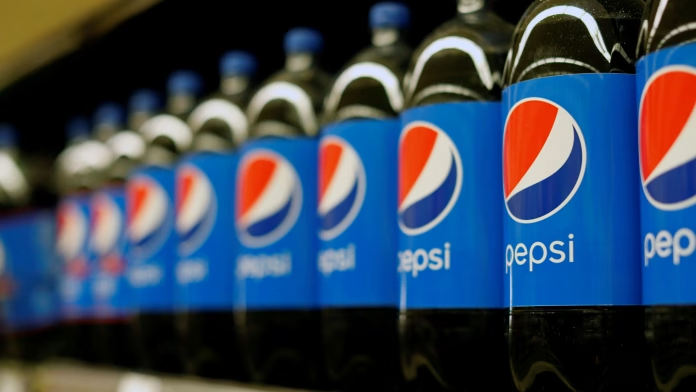
Global food and beverage corporation, PepsiCo, reported on Tuesday that its Indian division experienced “double-digit organic revenue growth” during the first quarter of 2023. According to PepsiCo’s global earnings statement, the beverage unit volume in the Indian market saw double-digit growth.
The convenient foods unit, on the other hand, witnessed a low-single-digit decline in volume in the Indian market during the quarter that concluded on March 25, 2023.
PepsiCo’s first quarter, which lasted for 12 weeks, came to an end on March 25, 2023.
The year-on-year comparison pertains to the 12-week period that ended on March 25, 2023, in contrast to the 12-week period that concluded on March 19, 2022.
PepsiCo’s net revenue in the Africa, Middle East, South Asia (AMESA) division, which includes India, increased by 1.49% to USD 1.01 billion, as compared to USD 1 billion. The rise was primarily due to effective net pricing, but was partially offset by a decline in organic volume.
Despite this, PepsiCo’s gross profit for the March quarter declined by 6.6% to USD 168 million due to the effects of increased commodity costs, particularly for cooking oil and packaging materials, as well as certain operating cost hikes and higher advertising and marketing expenses.
“Each of our international divisions reported a strong organic revenue growth, led by AMESA, which delivered double-digit organic revenue growth in both beverages and convenient foods during the quarter with India, Egypt, Saudi Arabia and Pakistan each delivering double-digit organic revenue growth and South Africa delivering high-single-digit organic revenue growth,” it said.
PepsiCo possesses well-known brands like Lay’s, Doritos, Cheetos, Gatorade, Pepsi-Cola, Mountain Dew, and Quaker.
During the (March) quarter, in AMESA zone, PepsiCo “beverage unit volume grew 15 per cent, primarily reflecting double-digit growth in India, partially offset by a low-single-digit decline in Nigeria,” it said.
The volume of the Convenient Foods unit in the AMESA region decreased by 8%, due to a double-digit decline in South Africa, which was partly offset by double-digit growth in the Middle East.
“Additionally, India and Pakistan each experienced a low-single-digit decline,” it said.
In the first quarter, PepsiCo’s net revenue increased by 10.2% to reach USD 17.85 billion.
Ramon Laguarta, the Chairman and CEO of the company, expressed his satisfaction with the first-quarter results, as the business achieved a 14.3% organic revenue growth and an 18% core constant currency earnings per share growth.
PepsiCo has revised its 2023 projections upward.
“Given the strength of our business performance, we now expect our full-year 2023 organic revenue to increase 8 per cent (previously 6 per cent) and our core constant currency earnings per share to increase 9 per cent (previously 8 per cent),” it said.
We use cookies to ensure that we give you the best experience on our website. If you continue to use this site we will assume that you are happy with it.