Thursday, December 18, 2025
Home Blog Page 11

Pan Masala Labeling Update: RSP Display Mandatory Across All Pack Sizes

0

The Department of Consumer Affairs has issued a major update to pan masala packaging regulations, mandating that all packs, regardless of size, display the Retail Sale Price and other statutory declarations. The notification, issued through GSR 881(E), will take effect from February 1, 2026, ending the long-standing exemption for small packs weighing 10 grams or less.

Under the amended Legal Metrology (Packaged Commodities) Rules, 2011, manufacturers, packers, and importers of pan masala will be required to ensure full compliance. The changes are aimed at strengthening consumer protection by providing transparent pricing information across all pack sizes and eliminating the possibility of misleading or inconsistent pricing.

Previously, smaller packs were not required to carry the retail price, often making it difficult for consumers to compare costs or for authorities to verify correct taxation. The government said that by enforcing uniform labeling, consumers will be better informed about the products they purchase and the prices they pay.

The amendment also aligns with tax compliance objectives. Displaying the Retail Sale Price facilitates accurate application of Goods and Services Tax on all pan masala products. This is expected to support seamless enforcement of RSP-based GST decisions by the GST Council and ensure proper revenue collection across every pack size, from the smallest single-serving sachet to bulk units.

Officials note that the move reflects a broader push for clarity in packaged commodities, where consumer awareness and transparency are priorities. Industry participants are advised to adjust their production, labeling, and supply chain processes to meet the February deadline, avoiding penalties for non-compliance.

The Department of Consumer Affairs emphasized that the amendment not only enhances regulatory oversight but also empowers consumers to make informed purchasing decisions, strengthening trust in product pricing across the pan masala market.

Advertisement

Government Moves to Restore Tobacco Excise Duty as GST Cess Nears End

0

The Union government has moved to ensure that taxes on tobacco products do not fall after recent changes to the GST framework, with Finance Minister Nirmala Sitharaman telling Parliament that the proposed excise duty on cigarettes and other tobacco items is simply a continuation of the tax structure that existed before GST. Speaking during a debate on the Central Excise Amendment Bill in the Lok Sabha, she emphasised that the measure is not an additional levy and that states will receive their share of the revenue as part of the divisible pool.

The move comes as the GST compensation cess, currently applied to all tobacco products, prepares to sunset. The cess was introduced in 2017 for a five-year period to help states adjust to the new tax regime and later extended to 2026 so the Centre could repay a loan of 2.69 lakh crore that was taken during the pandemic years. Officials expect that loan to be fully settled within the next few weeks, after which the cess will end and the revised excise structure will take effect.

Under the Bill, the government proposes excise duty ranging from 2,700 to 11,000 rupees per thousand sticks of cigarettes depending on size and category. It also lays out a duty of 60 to 70 per cent per kilogram on tobacco used in various products and a full 100 per cent per kilogram on chewing tobacco. Sitharaman noted that cigarette affordability in India has remained largely unchanged over the past decade, citing a World Health Organisation finding that stagnant prices undermine public health goals.

India’s total tax incidence on cigarettes currently sits at around 53 per cent of the retail price. This is well below the WHO benchmark of 75 per cent and lower than rates in markets such as the United Kingdom and Australia, where total tax routinely crosses 80 to 85 per cent. The minister added that the aim is to prevent tobacco products from becoming cheaper once the cess ends, while continuing efforts to help farmers move away from tobacco cultivation.

Advertisement

Google Rolls Out AI Try-On Feature in India for Realistic Outfit Previews Across Billions of Listings

0

Google has begun offering Indian shoppers a new way to judge an outfit before spending a rupee. The company has introduced virtual try-on for apparel across its shopping results in India, allowing users to see how clothing might look on their own bodies simply by uploading a full-length photograph. The rollout brings India into a growing list of markets where Google has been testing AI-assisted fitting tools.

The experience is straightforward. When browsing apparel listings on Google, shoppers will now notice a small prompt that invites them to try the item on. Once a photo is uploaded, Google’s system analyses the person’s body shape, studies how different materials behave, and then produces an image of the outfit on that individual. Tops, dresses, jackets, trousers and shoes are supported at launch, effectively covering most of the mainstream fashion categories searched on the platform.

The tool was first introduced in the United States earlier this year, followed by launches in Australia, Canada and Japan. Google says users in these markets tend to share their virtual try-on images more often than standard product photographs, which the company sees as a sign that shoppers enjoy the personalised, playful nature of the feature.

India already has a strong culture of digital try-before-buy. Myntra’s beauty try-on helped significantly improve conversion rates for makeup. Lenskart familiarised the country with 3D eyewear trials. Nykaa, Ajio, Tata Cliq and CaratLane have each experimented with similar technology over the years. Google is betting that a universal, platform-wide version will help customers feel more confident about sizing, fit and drape, ultimately reducing returns during peak buying months.

Its arrival also coincides with a busy shopping period that includes weddings, office celebrations and festive gatherings. For many users, the fitting room is now as close as the camera on their phone, and the final choice may depend on how convincingly the outfit appears on their own screen.

Advertisement

Prada Buys Versace for 1.4 Billion Dollars as Luxury House Prepares for Major Transformation

0

The Prada Group has formally taken ownership of Versace after completing a 1.375 billion dollar cash purchase that brings one of Italy’s boldest luxury labels into the fold of one of its most influential fashion houses. The deal moves Versace out of Capri Holdings and places it beside Prada and Miu Miu, marking one of the most significant restructurings in European luxury this decade.

Regulatory approvals were finalized earlier this week. Capri Holdings confirmed that proceeds from the sale will help reduce its existing debt. Prada, in its brief confirmation note, signaled that the transaction is part of a larger plan to expand its footprint while unlocking new value from Versace, which has struggled to find its momentum in recent years.

Donatella Versace publicly embraced the transition in an Instagram tribute timed with the birthday of Gianni Versace. The post featured an archival photograph of her brother with Miuccia Prada, underscoring the emotional weight of the moment for the family and the brand.

Versace’s next chapter will be led by Lorenzo Bertelli, who takes on the role of executive chairman alongside his existing responsibilities within Prada Group. Bertelli has indicated that dramatic leadership shakeups are unlikely in the near term, although he acknowledged that the brand’s global influence has not matched its recognition in recent years. Prada maintains that Versace still holds substantial room for growth, especially with its strong name recall in key markets.

Industry analysts see potential in the combination of Prada’s minimalism and Versace’s maximalist identity. Versace has already started refining its creative direction under designer Dario Vitale, who presented his debut collection in Milan earlier this year.

Behind the scenes, preparations are underway to integrate Versace into Prada’s Italian production network. The group has continued to expand its manufacturing capacity in Tuscany and beyond, investing heavily in training programs that support hundreds of artisans each year. Prada believes this manufacturing strength will be central to Versace’s revival.

Advertisement

Patanjali Cow Ghee Fails Safety Tests, Uttarakhand FDA Fines Company Rs 1.4 Lakh

0

Patanjali Ayurved Limited, the consumer goods company founded by yoga guru Ramdev, along with two associated businesses, has been collectively fined Rs 1.4 lakh by Uttarakhand’s Food Safety and Drug Administration following repeated failures of its cow ghee in food safety tests. The penalty includes Rs 1 lakh on Patanjali, Rs 25,000 on the distributor, and Rs 15,000 on the retailer.

The action follows inspections carried out in October 2020 when a sample of Patanjali cow ghee was collected from a general store in the Kasni area of Pithoragarh district. Laboratory analysis at the state-run facility in Rudrapur indicated that the product did not meet prescribed food safety standards and could potentially be harmful if consumed.

After the Rudrapur lab flagged the issue, the authorities issued a notice to Patanjali in 2021. The company requested a re-examination at the National Food Laboratory in Ghaziabad. In November 2021, the NFL confirmed the findings of the state lab, validating concerns over the quality and safety of the ghee.

The matter was subsequently reviewed by the Adjudicating Officer in Pithoragarh in February 2022, resulting in the imposition of fines. The Uttarakhand Food Safety and Drug Administration noted that repeated non-compliance necessitated regulatory action to protect consumers and ensure adherence to safety standards.

Patanjali has faced scrutiny in the past over product quality issues, and this development underscores ongoing challenges in maintaining consistency across its rapidly expanding portfolio. Authorities emphasized that regular monitoring and lab testing remain crucial in safeguarding public health and that penalties, though modest, serve as a deterrent against violations in the food and consumer goods sector.

The case highlights the intersection of regulatory oversight and corporate accountability in India’s booming packaged foods market, with consumer safety remaining a central concern for authorities nationwide.

Advertisement

Swiggy Plans Rs 10,000 Crore Share Sale to Raise $1.1 Billion from Institutional Investors

0

Indian food delivery company Swiggy is preparing one of its largest fundraising moves to date, with plans to raise up to Rs 10,000 crore from institutional investors as early as next week, according to people with knowledge of the discussions. The move signals the Bengaluru-based firm’s attempt to strengthen its balance sheet ahead of an expected public listing and a period of increasing competition in the quick-commerce and food-delivery market.

Sources say Swiggy has shortlisted three banks to guide the transaction: the Indian arms of Citigroup and JPMorgan Chase, along with Kotak Mahindra Capital. These advisors have been working closely with the company since the board cleared the proposal on November 7, allowing Swiggy to pursue a qualified institutional placement of shares. The final size and exact timing of the offering may still shift, depending on market conditions and regulatory clearances.

The proposed fundraising round comes at a time when India’s food-delivery and hyperlocal logistics sector is witnessing aggressive capital deployment from global and domestic players. Swiggy, valued at more than $10 billion in earlier private rounds, has been focusing on improving profitability in its restaurant-delivery business while expanding Instamart, its quick-commerce arm that continues to attract both demand and investment interest.

Analysts note that a Rs 10,000-crore infusion would give Swiggy additional room to invest in logistics, technology infrastructure and market expansion. It would also help bolster its position against chief rival Zomato, which has strengthened its balance sheet through recent profitability improvements and capital-market gains.

Representatives for Swiggy and the involved banks did not immediately comment on the fundraising plans. Market observers expect clearer details once shareholder and regulatory processes move forward, likely placing the company on a closer path toward its long-anticipated public debut.

Advertisement

Hiyo Partners with Live Nation; Social Tonics to Roll Out Across Major U.S. Music Festivals

0

Live Nation has entered a multi-year partnership with Hiyo Social Tonics, marking one of the beverage brand’s most significant commercial breakthroughs as it looks to embed itself in the fast-growing non-alcoholic drinks space in the United States. The agreement, which also includes an equity investment from Live Nation, will bring Hiyo’s functional, mood-enhancing drinks to select venues and festivals across the country.

The collaboration arrives at a moment when live-event consumers are increasingly seeking alternatives that offer flavour, energy and sociability without alcohol. Live Nation’s own research indicates that nearly six out of ten concertgoers shift between alcoholic and non-alcoholic drinks during a show, and eight in ten say that the beverage they choose influences how memorable the overall experience feels. For Hiyo, this data underscores a shift already visible in retail aisles and nightlife spaces.

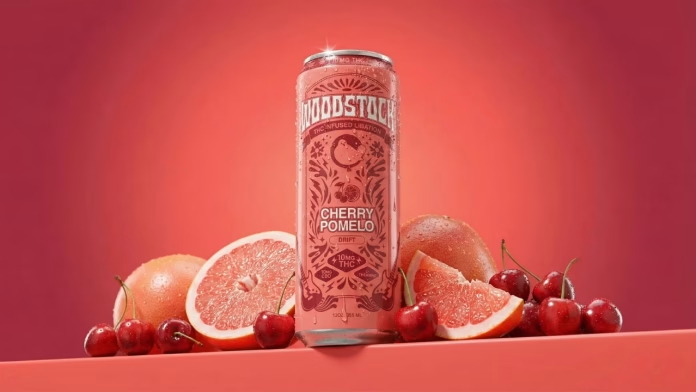
Hiyo’s range is built around blends of adaptogens, nootropics and botanicals designed to create what the brand describes as an uplifting, clear-headed feeling. Fans will first encounter the Blackberry Lemon variant at participating Live Nation events, positioning the drink as a refreshing, low-calorie option suitable for warm outdoor festivals or late-night concerts.

Evan Quinn, the company’s chief executive, called the partnership a turning point, saying it brings the brand directly into spaces where consumers are actively redefining how they connect and celebrate. Chief strategy officer Ian Knowles added that the alliance allows Hiyo to meet audiences during cultural moments when they are most open to trying new formats.

The investment extends Live Nation’s growing portfolio of emerging food and beverage companies, which already includes names such as Liquid Death and Owen’s Craft Mixers. Tom Allison, senior vice president of new ventures, said the rise of balanced consumption at shows makes Hiyo a timely addition, reflecting how fan preferences continue to evolve inside the modern concert economy.

Advertisement

Nothing Before Coffee Sees 52% Store Expansion, Strengthens Presence in Tier-II and Tier-III Cities

0

Nothing Before Coffee, the homegrown quick-service coffee chain, has posted remarkable growth in the current fiscal, reporting a 70 percent rise in revenue between March and October 2025. The surge reflects increasing consumer demand for the brand’s youth-oriented, affordable coffee offerings across non-metro markets, company officials said.

Alongside the financial momentum, NBC has expanded its footprint aggressively, growing its store network by 52 percent during the same period. The chain now operates over 100 outlets across 39 cities and is targeting 150 stores by the end of FY26. Recent launches include its fourth store in Surat, second in Vadodara, and third in Ahmedabad, consolidating its presence in Gujarat, one of its fastest-growing markets. The brand has also entered Zirakpur in Punjab, marking the start of an ambitious expansion into North India, including key locations in Punjab and Uttar Pradesh.

Co-founder Akshay Kedia attributed the growth to disciplined unit economics and sustained consumer traction. “Our strategy focuses on reinforcing density in high-performing states while selectively entering new markets that align with our national expansion plans,” he said.

Founded in 2017, NBC has differentiated itself through its signature beverage line, Shrappe, accessible pricing, and community-focused café spaces. The company continues to strengthen supply chain efficiencies, enhance operational processes, and expand its innovation pipeline to sustain growth.

With its current pace, NBC aims to deepen penetration in metros while capturing fast-growing Tier-II and Tier-III cities. The chain’s strategy emphasizes a balance between affordability and premium experience, aiming to position itself as a robust India-first challenger in the increasingly competitive café segment. Industry analysts note that the brand’s focus on youth-driven consumption, regional expansion, and operational discipline could set benchmarks for scaling coffee chains in emerging Indian markets.

Advertisement

LVMH Invests in BDK Parfums as Luxury Fragrance Sales Soar 45%

0

LVMH has taken a minority stake in Paris-based fragrance house BDK Parfums, signaling continued investor interest in niche luxury perfumery. The investment was made through LVMH Luxury Ventures, the corporate venture arm tasked with identifying emerging luxury brands with strong growth potential, according to WWD.

BDK Parfums, founded in 2016 by David Benedek, has steadily built a reputation for creative and high-quality fragrance offerings. The brand’s portfolio spans classic, unisex, and experimental scents, catering to both traditional fragrance connoisseurs and younger audiences seeking distinctive olfactory experiences. Sales at BDK Parfums have surged 45% year-over-year, reflecting growing consumer appetite for specialized luxury fragrances and an effective international distribution strategy.

Earlier this year, the brand opened its first flagship store in Paris, a move intended to strengthen its retail presence and brand identity. BDK Parfums plans to prioritize international expansion in the near term, leveraging both boutique and online channels to reach a wider audience. Analysts suggest the LVMH backing will accelerate these efforts and provide strategic guidance in marketing, retail, and global distribution.

The deal also comes amid a broader surge in activity across the fragrance segment. Estee Lauder invested in direct-to-consumer scent brand XINÚ, while VMG backed Snif. TSG Consumer acquired PHLUR, and L’Oreal has made two strategic acquisitions, taking stakes in both Amouage and Creed. These moves indicate strong confidence in the growth potential of luxury and niche fragrance brands, as consumers increasingly seek high-quality, personalized scent experiences.

For LVMH, the minority investment strengthens its footprint in the high-margin luxury fragrance category, aligning with the group’s long-term strategy of diversifying its portfolio with emerging brands that have both creative credibility and scalable growth potential. BDK Parfums is expected to benefit from capital infusion, operational expertise, and access to LVMH’s extensive international network as it accelerates global expansion.

Advertisement

The Body Shop India Ramps Up Sustainability, Refill Stations, and Store Count in a Push Toward One Thousand One Hundred Crore Rupees in Five Years

0
Image-of-the-body-shop
The Body Shop India Ramps Up Sustainability, Refill Stations, and Store Count in a Push Toward One Thousand One Hundred Crore Rupees in Five Years

The Body Shop India has set an ambitious target for its next five years, aiming to double its retail footprint and reach revenue of about one thousand one hundred crore rupees. The company revealed this plan as it approaches its fiftieth global anniversary, marking a new phase of growth for the ethical beauty brand.

In India, The Body Shop has steadily built a loyal consumer base that values clean ingredients, fair trade sourcing, and cruelty free products. The leadership team believes this is the right moment to scale up. The brand intends to open numerous new stores across metros and tier two cities, strengthen its online presence, and deepen its focus on omnichannel convenience. Its goal is to make the brand more accessible to younger shoppers while also keeping long time customers engaged.

The current strategy places strong emphasis on store experience. Newer outlets feature warm lighting, recycled materials, and community centric storytelling that highlights the brand’s activist roots. Executives say that stores are still the heart of the business in India because customers enjoy trying products, learning about ingredients, and speaking with trained consultants.

The company also plans to expand its refill stations, which have received positive consumer feedback. These stations encourage shoppers to reuse bottles and reduce plastic waste, reinforcing the brand’s sustainability commitments.

Founded in 1976 in Brighton by Anita Roddick, The Body Shop remains one of the most recognised champions of purpose led beauty. As the Indian market continues to grow, the company is confident that its mix of ethically sourced products, strong brand trust, and a rapidly expanding retail network will help it reach its next milestone.

Advertisement