Tuesday, December 23, 2025
Home Blog

Start following Kiara Advani’s simple yet powerful morning ritual for glowing skin

Have you ever stopped to marvel at Kiara Advani’s radiant and flawless skin? In the exquisite glamour that is Bollywood, Kiara Advani stands out not just for her acting genius but also for her luminous and healthy skin. Amidst the overwhelming myriad of options surfaced by the beauty industry, this simple yet transformative ritual is not only a fad, but the cornerstone of her radiance.


The secret might be simpler than you think. It’s not a gruelling workout or a 10-step skincare routine; it’s a simple cup of warm water, with a slice of lemon in it. Kiara’s morning habit of indulging in warm water infused with the zest of fresh lemons has become a conscious choice rooted in her approach to holistic well-being. The actress recommends this refreshing elixir not only for its skin-enhancing benefits but also for the multiple benefits it has in improving your overall health and vitality.  

 

Hansa Yogendra, Director of The Yoga Institute in one of her videos on the health benefits of lemons mentioned, “Drinking one glass of lemon water every day in the morning will benefit you for a lifetime”.  Her claim can further be supported by a research published in the Journal of Science and Technology which reveals that “It is a healthy appetiser and helps to treat diseases with digestive aids. Lemon does not disclose any adverse effects, according to literature, but it is used all over the world as a traditional medicine”. Vitamin C, which is abundantly present in lemons, fights toxins and increases collagen production in the body, both of which help in treating acne as well as tightening the skin and reducing fine lines and wrinkles. While lemons are famously known for their Vitamin C component, not many people are aware of their Potassium-rich skin, which is an important mineral for nervous stimulation as well as maintaining blood pressure. Here are a few more benefits of adding lemon water to your everyday diet:- 

  • Immediately soothes muscle cramps
  • Peptin in lemons makes us feel fuller, thereby, helping in weight loss
  • Boosts immunity by stimulating the production of White Blood Cells in the body
  • Removal of kidney stones 
  • The lemon peel when infused in water for 30 minutes, activates its bioactive compounds which boost immunity and prevent our bodies from cellular damage
  • It also helps in the release of digestive enzymes which help in better absorption of nutrients

 

This simple kitchen hack has proudly made its way into the celebrity wellness circuit. Not only Kiara Advani but also Alia Bhatt, Deepika Padukone, Kriti Sanon, and Malaika Arora have this one drink in common at the break of dawn.

Here are 3 ways, you can incorporate the lemon water glow into your morning routine:- 

  1. Warm ginger lemon tea- Boil a glass of water with crushed ginger. When its done, squeeze a lemon into your glass and have it warm. To enjoy it in place of your morning tea, you may add a teaspoon of honey to it.

2. Ginger lemon shot – Take an inch of ginger root, and one squeezed lemon. Add enough water to blend it (3-4 tablespoons) in a blender, and have it as a morning shot.

3. Lemon-infused detox water- Cut up slices of one lemon and add it to your water bottle. Have 1-2 glasses of lemon water in the morning, and keep having the rest throughout the day. 

While lemon water offers a myriad of health benefits, it’s crucial to exercise moderation. One lemon a day is a healthy limit, and people with gastroesophageal reflux disease should be cautious about excessive lemon juice intake. As with any dietary rituals, balance is key to ensuring you enjoy the advantages without overdoing it. 
Quick Commerce Ad Costs Squeeze FMCG Margins, Profits Near Kirana and Modern Trade Levels

0

India’s quick commerce boom is entering a more complex phase for FMCG companies, as the channel’s once-attractive profitability begins to thin under the weight of rising advertising costs. What started as a high-margin, premium-led sales avenue is now delivering returns closer to those seen in kirana stores and organised retail, according to senior industry executives.

Quick commerce platforms have increasingly leaned on advertising as a key revenue lever, auctioning prime digital shelf space, search rankings and high-traffic time slots. With consumers making purchase decisions in under a minute on these apps, brands are compelled to pay more to remain visible. Executives say this pressure has sharply increased the cost of doing business, narrowing margins across categories.

Angshu Mallick, executive deputy chairman at AWL Agri Business, noted that brands outside the top three or four listings in price-sensitive categories risk losing relevance altogether. With shoppers typically spending just 30 to 40 seconds browsing, sustained visibility now demands higher marketing investments. Advertising spends on quick commerce platforms have nearly doubled during peak windows such as early mornings and early evenings, executives said.

As a result, margins in segments like biscuits and snacks have slipped to around 13 to 15 percent, broadly in line with modern trade. Premium products still command higher margins of 20 to 22 percent, but even these have dropped by three to five percentage points over the past three to six months.

Zydus Wellness chief executive Tarun Arora said quick commerce initially delivered superior margins due to premium product mix, faster inventory turns and lower distribution costs. That edge has reduced as platforms prioritise their own profitability and drive harder commercial negotiations with brands. Even so, he said the channel remains commercially viable given its strong sales momentum.

Despite margin compression, quick commerce continues to be the fastest-growing channel for FMCG companies including Hindustan Unilever, ITC, Dabur, Marico and Emami. For HUL, quick commerce sales doubled in the first half of the current financial year, even as general trade continues to account for the bulk of revenue.

As platforms monetise scale through advertising, FMCG firms are recalibrating their strategies, balancing growth against profitability in a channel that is no longer the easy margin win it once was.

Advertisement

Anushka Sen Joins NowYouKnow as Brand Ambassador and Investor to Power Social-First Food and Travel Discovery

0

Actor and digital creator Anushka Sen has come on board as the brand ambassador and investor for NowYouKnow (NYK), a social-first travel and food discovery platform that is positioning itself as an alternative to public ratings and anonymous reviews.

Founded in 2023 by siblings Krishna and Pia Shivdasani, NowYouKnow is built around a simple idea: people trust recommendations from those they actually know. The platform allows users to privately save, organise and share recommendations for restaurants, cafés, bars, hotels and local finds within their personal network, replacing scattered notes, screenshots and chat threads with a single, curated space.

The company said Sen’s association goes beyond a typical celebrity endorsement. Along with lending her face to the brand, she has also taken an equity stake, signalling long-term belief in the product and its direction. NYK believes Sen’s everyday behaviour around saving places, exchanging suggestions with friends and documenting food experiences mirrors how modern consumers discover places today, making her a natural fit for the platform.

Sen, who commands a large and engaged digital following, said travel and food are deeply tied to memory and emotion for her. She noted that recommendations among friends are frequent but often fragmented across apps. According to her, NYK stood out because it felt private, intuitive and rooted in trust rather than popularity metrics. She described the platform as community driven, designed around authentic opinions and personal taste rather than mass validation.

Krishna Shivdasani, co-founder and CEO, said discovery is inherently personal and that a single aggregated rating cannot reflect India’s diversity. He added that recommendations only carry value when the context and credibility of the person sharing them are understood. In his view, Sen’s digital presence, built on relatability and sincerity, aligns closely with NYK’s core philosophy.

As food and travel discovery increasingly shifts away from public reviews toward trusted social circles, NowYouKnow is betting on a model where authenticity, privacy and personal networks define how choices are made. Sen’s involvement strengthens that positioning as the platform looks to scale among young, digitally native users.

Advertisement

Nikhil Kamath and Kishore Biyani Launch The Foundery With a 90 Day Build or Break Model

0

Nikhil Kamath and Kishore Biyani have come together to launch The Foundery, a new residential startup programme designed to help early stage founders build real businesses in just 90 days. Positioned as a co founder factory, The Foundery is built around one clear idea. Execution matters more than theory.

Unlike traditional accelerators that rely heavily on pitch decks and classroom style sessions, The Foundery focuses on doing the work. Founders live and work on campus, taking ideas from concept to an investible business with constant operator led support. The aim is simple. Strip away noise, move fast, and build something that can survive in the real market.

The programme blends elements of a venture studio, a startup school, and an accelerator. Participants work closely with experienced operators and domain experts to validate ideas, build products, test demand, and structure companies from the ground up. Instead of chasing vanity metrics, the emphasis stays on fundamentals like customer insight, distribution, unit economics, and speed.

For Kamath, who has backed and built multiple internet first businesses, the model reflects a belief that India needs more builders who understand execution early. For Biyani, whose career spans decades of building consumer businesses, The Foundery is a way to pass on hard earned lessons that rarely make it into textbooks.

At a time when startup funding has become more selective, the timing feels deliberate. The Foundery is not trying to create the next hype cycle. It is trying to create founders who can build with discipline, clarity, and resilience.

If it works as intended, The Foundery could quietly shape a new generation of Indian startups. Not polished on day one, but grounded, tested, and ready for the long game.

Advertisement

Popeyes Enters Airport Dining with First India Outlet at Mumbai International Airport

0

Popeyes has entered India’s airport foodservice landscape with the launch of its first outlet at Chhatrapati Shivaji Maharaj International Airport in Mumbai, signalling a sharper focus on high-traffic travel locations as part of its broader expansion strategy. The new restaurant is located at the Terminal 2 forecourt, one of the country’s busiest aviation hubs and a key gateway for domestic and international travellers.

The airport opening comes just months after Popeyes debuted in the Mumbai market, reinforcing the brand’s intent to build visibility in premium consumption zones beyond high streets and malls. With passenger volumes at Mumbai T2 among the highest in India, the location offers a strong platform for brand discovery, trial and repeat engagement.

The outlet serves Popeyes’ core global and India-specific menu, including its flagship Chicken Sandwich, Signature Fried Chicken, Boneless Chicken with international flavour profiles, and the Hot and Messy range curated for local tastes. The brand continues to follow its Louisiana-style Cajun cooking process, with chicken that is freshly prepared, hand-battered, hand-breaded and marinated for 12 hours before cooking.

Sameer Khetarpal, CEO and Managing Director of Jubilant FoodWorks Limited, which operates Popeyes in India, said airports have evolved into important consumer touchpoints rather than just transit zones. He noted that the Mumbai airport launch is aimed at engaging a high-intent audience and extending Popeyes’ presence into travel-led destinations following a positive response in the city since August.

The outlet has been launched in partnership with AMRL, a key player in airport food and beverage operations. An AMRL spokesperson said airports are increasingly being shaped as lifestyle destinations, with dining playing a central role in the traveller experience. The partnership with Popeyes, the spokesperson added, aligns with the goal of offering globally recognised brands at India’s leading airports.

The Mumbai T2 Popeyes outlet is currently operational and offers both dine-in and takeaway options. The launch adds to Jubilant FoodWorks’ growing portfolio, which spans over 3,300 stores across six international markets and includes global brands such as Domino’s, Popeyes and Dunkin’, alongside its own homegrown concepts.

Advertisement

The Golden Age of Indian Entrepreneurship Comes With a Catch, And Nikunj Biyani Says The Foundery Is the Missing Link

0

In a recent LinkedIn post, Nikunj Biyani, Co Founder of SuperYou, summed up what many Indian founders are quietly feeling. There has genuinely never been a better time to start up in India. Capital is flowing, ambition is high, and talent is no longer limited to metros alone. In 2024, Indian startups raised an estimated USD 10 billion across consumer, fintech, and SaaS, even in a cautious funding environment.

But Nikunj also points to the less glamorous truth. Early stage entrepreneurship is unforgiving. One wrong pricing decision, one poorly timed expansion, or one bad senior hire can set founders back by months and burn precious capital. Energy helps founders move fast, but speed without direction often leads to costly detours.

This is where experience becomes a force multiplier. Wisdom compresses time. It allows founders to learn from mistakes they have not yet made. According to Nikunj, access to experienced operators is like getting a glimpse of the road ahead before hitting the accelerator.

This is where the Foundery enters the picture. Unlike traditional incubators or passive investor networks, The Foundery positions itself as an active pit crew for founders building in the consumer ecosystem. Founders still drive the business, but they do so with seasoned operators fine tuning decisions around distribution, unit economics, brand building, and growth timing.

What makes The Foundery stand out is the depth of its network. It brings together some of the sharpest consumer minds in the country, people who have scaled brands from zero to hundreds of crores in revenue. The setup gives founders access to mentorship, infrastructure, and real world pattern recognition that usually takes years to build.

India does not suffer from a lack of hustle. What it lacks is structured access to wisdom. As Nikunj Biyani highlights, when energy meets experience, the outcomes can be explosive.

Advertisement

Starbucks Appoints Amazon Veteran Anand Varadarajan as Chief Technology Officer

0

Starbucks has named Indian-origin technology leader Anand Varadarajan as its new Executive Vice President and Chief Technology Officer, strengthening its leadership bench as the coffee major sharpens its focus on digital transformation and technology-led growth. Varadarajan will assume the role on January 19 and become part of Starbucks’ Executive Leadership Team, reporting directly to Chief Executive Officer Brian Niccol.

The appointment brings to Starbucks a senior technologist with nearly 19 years of experience at Amazon, where he played a central role in building and scaling large, customer-centric technology platforms. In his most recent position, Varadarajan oversaw technology and supply chain systems for Amazon’s Worldwide Grocery Stores business, a portfolio that demands high reliability, speed, and integration across physical and digital retail environments.

Starbucks said Varadarajan’s background in designing secure and scalable systems aligns closely with the company’s ambitions to modernise its global operations, improve store-level efficiency, and deepen digital engagement with customers. Technology continues to be a critical growth lever for the company, supporting mobile ordering, loyalty platforms, personalised marketing, and supply chain optimisation across thousands of stores worldwide.

Before joining Amazon, Varadarajan worked as a software engineer at Oracle and gained early entrepreneurial exposure through roles at several startups. He is an alumnus of the Indian Institute of Technology and holds a master’s degree in civil engineering from Purdue University, along with a master’s degree in computer science from the University of Washington.

Varadarajan succeeds Deb Hall Lefevre, who retired in September after a long tenure with Starbucks. The leadership transition comes at a time when the global coffee chain is investing heavily in technology to enhance customer experience, improve operational resilience, and support long-term growth in both mature and emerging markets.

Starbucks indicated that Varadarajan’s appointment is expected to accelerate its technology roadmap globally, bringing a sharper focus on execution at scale while keeping customer experience at the core of its digital strategy.

Advertisement

Scandalous Foods Enters Fusion Dessert Space with Mithai Sundaes, Targets HoReCa Growth by 2027

0

Scandalous Foods has stepped into India’s fast-evolving fusion dessert space with the launch of Mithai Sundaes, a new range designed exclusively for the HoReCa channel. The move marks a strategic expansion beyond the brand’s core portfolio of traditional Indian sweets and reflects changing consumption patterns among younger, urban diners.

The new line debuts with three single-serve formats aimed at post-meal indulgence in restaurants and catering settings. The offerings include Jamun Jubilee, a layered cup combining angoori rasgulla, rose syrup, rabdi and gulab jamun; Baked Rasgulla, which reimagines the classic sweet with a baked rabdi topping for a warm, caramelised finish; and Strawberry Mousse, a lighter dessert made with strawberries, cream cheese and whipped cream. Each SKU is built for visual appeal and portion-controlled consumption, aligning with current menu trends in casual dining and quick service formats.

Industry executives point out that while Indian mithai continues to enjoy strong household consumption, it struggles for visibility in restaurant menus and on visual-first digital platforms that influence Gen Z and young millennial preferences. Western desserts such as brownies and lava cakes dominate the single-serve category, leaving limited Indian alternatives that fit modern dining occasions. Scandalous Foods is positioning Mithai Sundaes to fill this gap by combining familiar flavours with contemporary presentation.

According to the company, product development was guided by growing demand for Indianised fusion desserts that retain traditional taste while fitting modern service formats. The brand plans to extend the concept to regional desserts, including South Indian varieties, in future phases.

Mithai Sundaes will be distributed through B2B and catering partners across India, with an initial focus on Bengaluru and Mumbai. Scandalous Foods has set a target of scaling the range to 9 lakh cups per month by 2027. As the rollout gathers pace, the company aims to deepen penetration across catering networks and explore opportunities within QSR and casual dining, signalling a broader push to modernise how Indian desserts are served and consumed outside the home.

Advertisement

KT&G Moves Delhi High Court Against 14 Illegal Operators Over Counterfeit ESSE Cigarettes

0

Korean tobacco major KT&G has initiated legal proceedings in the Delhi High Court against 14 entities accused of operating an organised network dealing in counterfeit ESSE cigarettes across the Delhi NCR region, as part of a stepped-up enforcement drive to curb illicit tobacco trade in India.

The lawsuit follows a series of court-mandated raids carried out simultaneously at multiple wholesale locations in Delhi NCR. Acting on the court’s directions, enforcement authorities, supported by KT&G and its legal counsel SS Rana & Co, seized large quantities of cigarette products bearing the ESSE trademark. Preliminary examinations indicated that the seized stock was unauthorised and illegally distributed, the company said in a statement.

According to KT&G, the action is aimed at dismantling parallel supply chains that feed counterfeit tobacco products into the market. Such products often evade regulatory oversight, bypass mandatory pictorial health warnings and are manufactured using unregulated raw materials, posing heightened health risks to consumers.

The company said the Delhi NCR operation is part of a wider national strategy to protect brand integrity, ensure consumer safety and uphold compliance within the legal tobacco market. KT&G has indicated that similar enforcement actions are being planned in other major consumption centres, including Mumbai, Bengaluru, Chennai and Hyderabad, signalling a broader crackdown on counterfeit cigarette networks.

Young-Hun Kim, director of the intellectual property division at KT&G headquarters, said the company would pursue both civil and criminal remedies against parties involved at every level of the illegal trade, including manufacturers, distributors, wholesalers and retailers. He added that safeguarding consumers’ access to genuine products remains a priority for the company in India.

Legal experts involved in the case noted that the growth of illicit and counterfeit cigarettes has emerged as a significant challenge for the tobacco industry and regulators alike. Vikrant Rana, managing partner at SS Rana & Co, said illegal tobacco trade not only undermines public health safeguards but also erodes government tax revenues and distorts fair competition within the market.

KT&G said it would continue working closely with enforcement agencies to address the issue and strengthen compliance across the supply chain.

Advertisement

Swiggy Instamart Tests Seller-Led Experiential Store in Gurugram, Marks First Offline Push in Quick Commerce

0

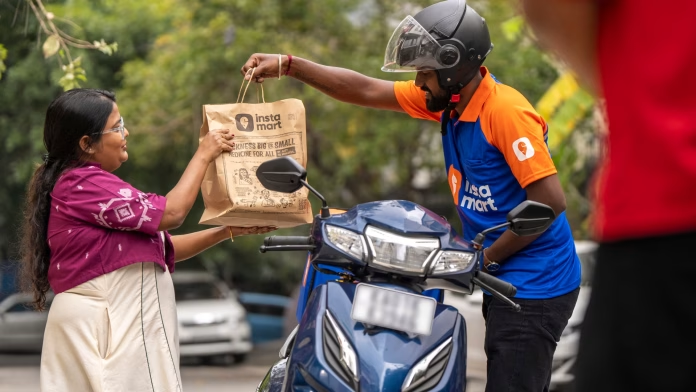
Swiggy’s quick commerce arm Instamart has begun testing an offline format with the launch of a compact experiential store in Gurugram, signalling a new approach to customer engagement in a category built almost entirely on app-led convenience. The pilot outlet, located at M3M 65th Avenue, marks Instamart’s first physical retail experiment and reflects how quick commerce players are reassessing discovery, trust and category depth as the market matures.

Unlike Instamart’s dark stores, which are designed purely for rapid fulfilment and stock thousands of products, the Gurugram outlet carries a sharply curated range of roughly 100 to 200 stock keeping units. The focus is on categories where physical inspection influences buying decisions, including fresh fruits and vegetables, pulses, select packaged foods, new product launches and offerings from emerging direct to consumer brands. Customers can walk in, browse and purchase on the spot, blending instant gratification with product confidence.

A key distinction of the model is its ownership structure. The store is seller owned and seller operated, functioning under the Instamart brand rather than as a Swiggy run retail outlet. Sales are settled directly with sellers, mirroring the platform’s marketplace approach while keeping the format asset light for Instamart. Industry sources estimate the store size at about 400 square feet, positioned close to residential clusters to encourage regular footfall.

The pilot comes at a time when India’s quick commerce sector is moving beyond speed alone. Platforms such as Instamart, Blinkit and Zepto are increasingly focused on improving unit economics, expanding high trust categories and building repeat usage. Consumer preferences are also evolving, with greater emphasis on quality assurance and product familiarity, particularly for perishables.

Swiggy has not outlined any formal plans for a wider offline rollout, positioning the Gurugram store as a test rather than a shift towards traditional retail. For industry observers, the experiment offers insight into how quick commerce companies may combine digital scale with selective physical touchpoints to deepen engagement, without materially increasing capital expenditure. Whether the format scales will depend on consumer response, seller viability and its ability to complement fast delivery networks effectively.

Advertisement

Under Armour targets ₹1,500 crore India retail revenue in five years with premium-led expansion strategy

0

Under Armour is preparing for its next phase of growth in India with a clear ambition to scale its retail business to nearly ₹1,500 crore over the next five years, driven by a premium positioning and an experience focused retail strategy. The brand, operated in India by Underdog Athletics, has stayed away from aggressive discounting and mass expansion, choosing instead to build equity through controlled distribution and consistent brand storytelling.

Since its India entry in 2019, Under Armour has grown at a compound annual rate of about 25 percent over the last three years. Retail value revenue stood at roughly ₹500 crore in FY25, providing a strong base for the next leg of expansion. According to Underdog Athletics managing director Tushar Goculdas, the strategy has remained unchanged from day one, with emphasis on performance credibility, premium design and in store experience rather than short term volume pushes.

Store level metrics underline the strength of this approach. A single 1,740 square foot outlet at Ambience Mall in Gurugram generated close to ₹1.5 crore in revenue in November alone. Select technology driven streetwear styles have seen faster than expected traction, with inventory originally planned for several months selling out within weeks. While performance apparel and footwear remain core, these limited additions have helped broaden appeal without diluting the brand’s athletic focus.

Footwear contributes around 35 to 37 percent of sales, apparel accounts for more than half, and accessories form the balance. Physical retail continues to anchor the business, generating about 60 percent of overall revenue. Women’s wear, currently a little over one fifth of sales, is steadily gaining ground.

Under Armour plans to open eight to ten new stores each year, expanding beyond its current presence in around 30 cities into select tier two markets as demand widens. With a calibrated digital strategy and long term sourcing opportunities emerging in South India, the brand is positioning itself for sustained, premium led growth in one of its fastest growing global markets.

Advertisement