Friday, January 2, 2026
Home Blog

Start following Kiara Advani’s simple yet powerful morning ritual for glowing skin

Have you ever stopped to marvel at Kiara Advani’s radiant and flawless skin? In the exquisite glamour that is Bollywood, Kiara Advani stands out not just for her acting genius but also for her luminous and healthy skin. Amidst the overwhelming myriad of options surfaced by the beauty industry, this simple yet transformative ritual is not only a fad, but the cornerstone of her radiance.


The secret might be simpler than you think. It’s not a gruelling workout or a 10-step skincare routine; it’s a simple cup of warm water, with a slice of lemon in it. Kiara’s morning habit of indulging in warm water infused with the zest of fresh lemons has become a conscious choice rooted in her approach to holistic well-being. The actress recommends this refreshing elixir not only for its skin-enhancing benefits but also for the multiple benefits it has in improving your overall health and vitality.  

 

Hansa Yogendra, Director of The Yoga Institute in one of her videos on the health benefits of lemons mentioned, “Drinking one glass of lemon water every day in the morning will benefit you for a lifetime”.  Her claim can further be supported by a research published in the Journal of Science and Technology which reveals that “It is a healthy appetiser and helps to treat diseases with digestive aids. Lemon does not disclose any adverse effects, according to literature, but it is used all over the world as a traditional medicine”. Vitamin C, which is abundantly present in lemons, fights toxins and increases collagen production in the body, both of which help in treating acne as well as tightening the skin and reducing fine lines and wrinkles. While lemons are famously known for their Vitamin C component, not many people are aware of their Potassium-rich skin, which is an important mineral for nervous stimulation as well as maintaining blood pressure. Here are a few more benefits of adding lemon water to your everyday diet:- 

  • Immediately soothes muscle cramps
  • Peptin in lemons makes us feel fuller, thereby, helping in weight loss
  • Boosts immunity by stimulating the production of White Blood Cells in the body
  • Removal of kidney stones 
  • The lemon peel when infused in water for 30 minutes, activates its bioactive compounds which boost immunity and prevent our bodies from cellular damage
  • It also helps in the release of digestive enzymes which help in better absorption of nutrients

 

This simple kitchen hack has proudly made its way into the celebrity wellness circuit. Not only Kiara Advani but also Alia Bhatt, Deepika Padukone, Kriti Sanon, and Malaika Arora have this one drink in common at the break of dawn.

Here are 3 ways, you can incorporate the lemon water glow into your morning routine:- 

  1. Warm ginger lemon tea- Boil a glass of water with crushed ginger. When its done, squeeze a lemon into your glass and have it warm. To enjoy it in place of your morning tea, you may add a teaspoon of honey to it.

2. Ginger lemon shot – Take an inch of ginger root, and one squeezed lemon. Add enough water to blend it (3-4 tablespoons) in a blender, and have it as a morning shot.

3. Lemon-infused detox water- Cut up slices of one lemon and add it to your water bottle. Have 1-2 glasses of lemon water in the morning, and keep having the rest throughout the day. 

While lemon water offers a myriad of health benefits, it’s crucial to exercise moderation. One lemon a day is a healthy limit, and people with gastroesophageal reflux disease should be cautious about excessive lemon juice intake. As with any dietary rituals, balance is key to ensuring you enjoy the advantages without overdoing it. 
Zomato, Blinkit Hit Record 75 Lakh Orders on New Year’s Eve Despite Gig Worker Strike Call

0

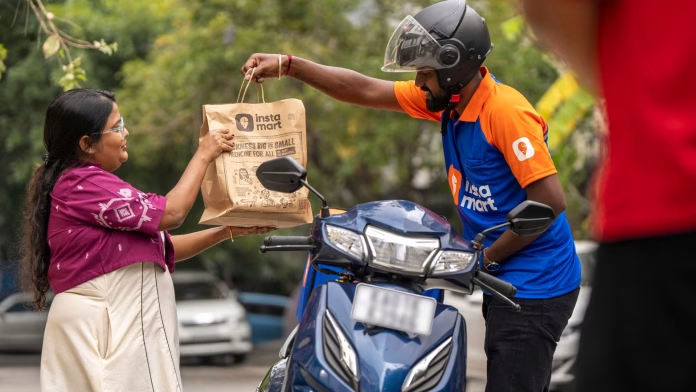
Food delivery major Zomato and quick commerce platform Blinkit closed 2025 on a historic high, clocking a combined 75 lakh orders on New Year’s Eve, even as sections of gig workers went ahead with a nationwide strike call. The milestone was confirmed by Deepinder Goyal, founder of Eternal, the parent company of both platforms.

In a post shared on social media, Goyal said more than 4.5 lakh delivery partners were active across Zomato and Blinkit on December 31, serving over 63 lakh customers in a single day. According to him, coordination with local law enforcement helped prevent disruptions, allowing operations to continue smoothly despite calls for work stoppages.

New Year’s Eve is traditionally the busiest day of the year for food delivery and quick commerce companies, and this year proved no different. Zomato offered delivery partners payouts of roughly Rs 120 to Rs 150 per order, in line with incentives offered during previous New Year periods. Goyal clarified that no extraordinary incentives were rolled out beyond the usual festive-day structure.

Labour unions, however, presented a contrasting picture. Worker groups including the Indian Federation of App-Based Transport Workers and the Telangana Gig and Platform Workers Union claimed that around 2.1 lakh gig workers participated in strikes on December 25 and December 31. Their demands centred on higher pay, improved safety conditions, social security benefits, and an end to ultra-fast delivery timelines, which they argue increase accident risks.

Despite the protests, companies had prepared extensively for the year-end surge. Industry executives said internal war rooms were set up to manage order spikes, logistics load, and customer support, continuing a trend seen over the past two years as New Year’s Eve order volumes hit fresh records annually.

Commenting on the broader debate, Goyal said the scale and consistency of participation from delivery partners reflected confidence in the platform model. He described the gig economy as one of India’s largest organised job creators, adding that its long-term impact would be felt as stable incomes enable better education and opportunities for workers’ families.

The record-breaking New Year performance underlines both the growing dependence on app-based delivery and the unresolved tensions shaping the future of gig work in India.

Advertisement

India to Hike Excise Duty on Cigarettes, Tobacco from February 1; Prices Likely to Rise

0

The Union government has announced a fresh round of excise duties on cigarettes and other tobacco products, a move that will take effect from February 1, 2026 and is expected to push retail prices higher across categories. The revised levy is part of a broader overhaul of tobacco taxation and will directly impact both consumers and manufacturers.

The Finance Ministry has notified the Chewing Tobacco, Jarda Scented Tobacco and Gutkha Packing Machines Rules, 2026, which lay down a new excise framework linked to production capacity and product specifications. Under the revised structure, cigarettes will attract an excise duty ranging from ₹2,050 to ₹8,500 per 1,000 sticks, depending on their length and category. This will be levied over and above the existing Goods and Services Tax, raising the total tax outgo on cigarettes and allied products.

The announcement had an immediate effect on equity markets. Shares of ITC, the country’s largest cigarette maker, fell nearly 2 percent, while Godfrey Phillips India declined over 4 percent in early trade. The broader FMCG index also edged lower, reflecting investor concerns around margin pressure and potential demand moderation following the price increase.

From February 2026, cigarettes and pan masala will continue to attract 40 percent GST, in addition to the newly introduced excise duty. Bidis will remain under a lower 18 percent GST slab, with duties applied as per existing norms. Other tobacco products such as chewing tobacco, gul and gutkha will be taxed at 40 percent GST along with excise duty and a Health and National Security Cess. The new cess will replace the current compensation cess, which will be withdrawn once the revised regime comes into force.

The legislative backing for the new taxes was cleared by Parliament in December through two reform bills. Officials say the changes are aimed at curbing tobacco consumption, improving revenue collections and streamlining the indirect tax structure. With prices set to rise, industry watchers expect shifts in buying behaviour, particularly in premium segments, even as companies reassess pricing and volume strategies in a tighter regulatory environment.

Advertisement

Kapil Sharma Launches Kap’s Cafe in Dubai, Marks Middle East Debut on New Year’s Eve

0

Indian comedian and television personality Kapil Sharma is closing out 2025 with an overseas business milestone, announcing the opening of Kap’s Cafe in Dubai on December 31. The launch marks the brand’s debut in the Middle East and its second international location after Surrey, Canada, signalling a broader push to build Kap’s Cafe into a global hospitality label.

The Dubai outlet was unveiled through a short promotional video shared on social media, featuring Sharma welcoming guests inside the new space. The visuals highlight a relaxed, contemporary café set against the city’s skyline, positioning the brand as a casual destination rather than a high-energy nightlife venue.

Kap’s Cafe has been designed as a lifestyle-led café, blending comfort dining with visual appeal. The interiors draw inspiration from the familiar aesthetic of The Kapil Sharma Show, using soft greens and pastel pinks to create a warm, Instagram-friendly environment. Early images suggest an intimate setting aimed at families, tourists, and café-goers looking for a quiet place to unwind.

The café will open to the public on December 31, operating from 4 pm to midnight. By choosing limited hours on New Year’s Eve, the brand appears to be targeting guests seeking a calmer alternative to large celebrations, with an emphasis on conversation, coffee, and comfort food.

While the Dubai menu has not yet been officially announced, the offerings are expected to mirror the brand’s Canada outlet. The Surrey café serves a mix of Indian street-style snacks such as vada pav alongside café staples including sandwiches, pasta, and a range of hot and cold beverages, from classic coffees to teas and matcha-based drinks. A similar blend of Indian and Western comfort fare is likely in Dubai.

Earlier this year, Kap’s Cafe in Canada faced temporary disruption following an incident that damaged part of the property. With the Dubai launch moving ahead as planned, Sharma’s latest venture underlines his intent to grow the café brand beyond entertainment and into an international food and lifestyle business.

Advertisement

Beauty Goes Instant Quick Commerce Drives $100 Million Monthly Sales in India

0

Quick commerce is rapidly redrawing the contours of India’s beauty and personal care market, turning what was once a considered online purchase into an almost spontaneous decision delivered within minutes. Skincare serums, makeup essentials and everyday beauty products are increasingly joining grocery baskets on instant delivery apps, signalling a structural shift in how consumers shop for beauty.

Industry estimates suggest beauty and personal care sales on quick commerce platforms have climbed to roughly $100 million in monthly gross merchandise value. That figure is approaching the average monthly beauty sales recorded by specialist online retailer Nykaa, underscoring how fast the category has scaled on ultra-fast delivery platforms. Until recently, quick commerce was largely associated with emergency grocery runs and household essentials. Beauty is now emerging as one of its strongest growth engines.

Executives say demand is rising across makeup, skincare and daily-use beauty items, with a notable tilt towards premium products. Zepto chief business officer Devendra Meel said the category has delivered some of the fastest growth on the platform this year, driven by higher discovery and impulse-led buying. Consumers are no longer waiting for planned sales or replenishment cycles and are instead opting for instant access.

Data from Redseer Strategy Consultants highlights the pace of this change. Beauty sales on quick commerce platforms grew 160 percent year on year in the most recent quarter, sharply outperforming the roughly 20 percent growth seen on traditional ecommerce channels. The speed, convenience and visibility offered by instant delivery are pulling demand away from slower formats.

Global and domestic brands are taking note. L’Oréal chief executive Nicolas Hieronimus recently said India has become a critical market as digital platforms allow brands to reach consumers nationwide with far greater speed and scale than before. For several direct-to-consumer and established beauty players, quick commerce already contributes between 7 percent and 25 percent of total sales. At Honasa Consumer, which owns Mamaearth and The Derma Co., the channel has emerged as its fastest-growing sales route, accounting for around a tenth of revenue.

As impulse buying replaces planned shopping, quick commerce is no longer just about speed. It is reshaping how beauty is discovered, purchased and consumed across urban India.

Advertisement

India’s Oldest Snack Brand Wins Big: Inside Haldiram’s $10 Billion Deal with Temasek, Alpha Wave and L Catterton

0

For years, India’s startup story was dominated by apps, fintech platforms, and SaaS companies chasing scale and valuations. Investors from around the world poured billions into digital-first ideas while traditional Indian consumer brands were largely overlooked. Quietly, a very different kind of business kept growing in kitchens, factories, and kirana stores across the country. That business was Haldiram’s.

Founded as a small bhujia shop in 1937, Haldiram’s built its empire the slow way. It focused on taste, consistency, distribution, and trust. Without flashy pitches or venture funding, it became a household name across India and a familiar sight in Indian stores abroad. This year, global capital finally took notice.

Temasek led the shift with a 9 percent stake investment valued at roughly ₹8,000 crore. Alpha Wave Global and Abu Dhabi based IHC followed soon after. Together, these deals pegged Haldiram’s valuation at around $10 billion, placing it among India’s most valuable consumer companies. The latest and most significant entry came from L Catterton.

L Catterton is not just another private equity fund. Backed by LVMH and Bernard Arnault, the firm has built and scaled some of the world’s strongest consumer brands. From luxury fashion houses to everyday food products like Cholula Hot Sauce and Kettle Chips, its playbook is about taking local favorites and turning them into global names.

For Haldiram’s, this partnership signals a new phase. Expect sharper brand storytelling, stronger global distribution, new product formats, and professional leadership depth. With Sanjiv Mehta, former HUL chairman, guiding India operations, execution will matter as much as ambition.

This moment is bigger than one company. It marks a shift in how global investors view Indian consumption. Legacy brands with deep roots, loyal customers, and proven profitability are no longer invisible. Sometimes, the smartest bet is not on the newest idea, but on the one that has worked for nearly a century.

Advertisement

Zepto Claims ₹17,000 Crore in User Savings in 2025 as Fastest Delivery Hits 48 Second

0

Quick commerce platform Zepto says 2025 marked a turning point in how Indians shop for everyday needs, with consumers ordering more frequently, spending more per transaction, and increasingly depending on ultra-fast deliveries for both essentials and impulse purchases.

According to the company’s year-end trends report, Zepto users collectively saved an estimated ₹17,000 crore over the year through what the company describes as sharper pricing and quicker access to daily items. While the firm did not detail the methodology behind the savings estimate, the figure highlights the growing scale at which quick commerce is influencing household spending.

Speed remained central to the platform’s pitch. Zepto reported its fastest delivery in 2025 was completed in just 48 seconds. Over the year, delivery partners travelled more than 2.45 billion kilometres, underscoring the operational intensity behind the promise of near-instant fulfilment. The app itself was opened over 34.6 billion times, reflecting how deeply embedded quick commerce has become in routine consumption.

User behaviour data also points to rising order values and frequency. One Mumbai-based customer placed a single order worth ₹1.89 lakh, while another user completed close to 5,900 orders in a year, averaging nearly 16 orders a day. Tipping trends showed a similar uptick, with a Gurugram customer tipping delivery partners a cumulative ₹54,000 across multiple orders.

City-level insights reveal both common staples and local quirks. Milk, vegetables and packaged snacks dominated carts in Bengaluru, alongside unexpected tech purchases such as over 69,000 Type-C charging cables. Mumbai logged heavy demand for bottled water and energy drinks, consuming over 7.8 lakh litres during the year. In Delhi NCR, everyday essentials topped orders, though preferences varied, with guavas favoured in North Delhi and avocados more popular in the south.

Hyderabad showed a mix of modern and traditional tastes, with strong demand for carbonated drinks alongside over 65,000 kilograms of Osmania biscuits. The report also noted a growing pattern of mixed baskets, where health-focused products often sit alongside indulgent food items, reflecting evolving consumer behaviour rather than rigid shopping categories.

Advertisement

Farmley FY25 Revenue Jumps 71% to ₹394 Cr as IIT-Founded Healthy Snacking Brand Scales Up

0

Noida-based healthy snacking company Farmley is closing in on the ₹400 crore milestone after posting strong growth in the financial year ended March 2025. Founded by IIT alumni Akash Sharma and Abhishek Agarwal, the company reported operating revenue of ₹394 crore in FY25, up sharply from ₹230 crore a year earlier, translating into a 71 percent year-on-year increase.

The performance reflects Farmley’s steady shift from a bulk supply model to a consumer-facing brand focused on everyday nutrition. The company sells a wide portfolio of dry fruits, roasted nuts, seeds, makhana snacks, trail mixes and date-based products, with its catalogue now spanning more than 100 SKUs.

Sales momentum during the year was driven by rising demand on ecommerce and quick commerce platforms, alongside deeper penetration into offline retail. Farmley currently sells through Amazon, Flipkart, Blinkit, Zepto and BigBasket, while also supplying to over 22,000 physical stores across India. Exports to markets including the US, Australia, Singapore and the Middle East contributed incremental growth.

Higher scale helped improve operating efficiency even as costs rose. Procurement of nuts and dry fruits remained the largest expense at ₹281 crore in FY25. Advertising spends climbed to ₹52 crore as the brand increased visibility across digital and rapid delivery platforms, while employee and logistics costs rose in line with geographic expansion. Total expenses stood at ₹419 crore, compared with ₹257 crore in FY24.

Despite remaining loss-making, Farmley continued to narrow losses. Net loss reduced to ₹22.5 crore in FY25 from ₹26.5 crore the previous year, with the operating loss margin improving to minus 3.68 percent.

The company has raised about $55 million to date, including a $40 million Series C round in May 2025 led by L Catterton. Founders retain a majority stake of roughly 52 percent. Farmley is now preparing to invest ₹40–50 crore in a new Noida manufacturing facility expected to come online by FY27, as it targets ₹600–700 crore in revenue in FY26.

Advertisement

Second Profitable Year in a Row: The Souled Store Posts Rs 11 Cr Profit as Revenue Jumps to Rs 492 Cr in FY25

0

D2C fashion brand The Souled Store has extended its profitability streak into FY25, reporting a net profit of Rs 11 crore, marking its second straight profitable year. While the bottom line remained in the black, profit declined 38 percent from Rs 17.7 crore in FY24, largely due to the absence of a tax credit that had boosted earnings in the previous year.

According to financial disclosures, the company recorded a tax outgo of Rs 1.8 crore in FY25, compared to a tax credit of Rs 7.6 crore in FY24. Despite this, profit before tax grew a healthy 26 percent year on year to Rs 12.8 crore from Rs 10.1 crore, pointing to improved operating performance at the core business level.

Revenue growth remained strong. Operating revenue rose 37 percent to Rs 492.4 crore in FY25, up from Rs 360.2 crore a year earlier. Including other income of Rs 7.9 crore, The Souled Store’s total income stood at Rs 500.1 crore, compared to Rs 368.5 crore in FY24. The growth reflects steady demand across online channels and expanding offline presence, along with higher average order values.

Founded in 2013 by Vedang Patel, Rohin Samtani, Aditya Sharma, and Harsh Lal, The Souled Store began as a licensed merchandise brand selling pop culture apparel. Over the years, it has evolved into a full fledged casual wear brand with a wide portfolio spanning t shirts, shirts, bottoms, and accessories.

The FY25 numbers suggest the brand is entering a more mature phase. Even as profitability dipped on paper due to tax adjustments, the underlying business continued to scale efficiently. In a D2C fashion market where many players are still struggling to break even, The Souled Store’s ability to grow revenue while staying profitable sets it apart and strengthens its position as one of India’s more disciplined consumer startups.

Advertisement

From Rs 7.3 Cr to Rs 29.1 Cr in a Year: How D2C Sneaker Brand Comet Scaled 4X in Its First Full Year

0

Homegrown D2C sneaker brand Comet has reported a sharp jump in revenue, with its topline nearly quadrupling to Rs 29.1 crore in FY25, up from Rs 7.3 crore in FY24. The surge comes on the back of rising demand for its products and a growing appetite for Indian sneaker labels among younger consumers.

FY25 was also the company’s first full financial year of operations. Comet began selling in July 2023 and scaled quickly through its own website and select offline touchpoints. Founded by Utkarsh Gupta and Dishant Daryani, the brand focuses on design led sneakers for both men and women and currently offers more than 15 SKUs across categories.

Apart from core sales, Comet earned Rs 2.7 crore from other income during the year. This included interest on bank deposits, interest on income tax refunds, and proceeds from the sale of scrap. This additional income pushed total revenue growth to over 300 percent year on year, highlighting how aggressively the business expanded during the period.

However, the rapid growth also came with rising costs. Comet’s net loss widened by 120.6 percent to Rs 4.4 crore in FY25, compared to a loss of Rs 2 crore in FY24. Higher spending on marketing, product development, inventory, and brand building contributed to the wider losses as the company focused on scale rather than short term profitability.

The numbers reflect a familiar pattern in India’s D2C space. Young brands are choosing to invest heavily in growth, even if it means absorbing losses in the early years. For Comet, the challenge ahead will be to convert strong demand and brand recall into sustainable margins. As competition heats up in the sneaker and lifestyle segment, how efficiently the brand balances growth with cost control will determine its next phase.

Advertisement

5 AM Threat Calls After a Rs 4,600 Order: How a Blinkit Delivery Dispute in Mumbai Dragged CEO Deepinder Goyal Into a Safety Storm

0

A late night Blinkit order in Mumbai has spiralled into a disturbing episode that has raised serious questions about customer safety and platform accountability in India’s quick commerce space. A Mumbai resident, Harsh Gupta Madhusudan, has alleged that he and his family received harassment and threat calls as early as 5 am from a Blinkit delivery partner following a dispute over a prepaid order.

According to details shared by Madhusudan on X, the order worth around Rs 4,600 was placed late at night and successfully delivered. However, the delivery partner later cancelled the order without any explanation. Blinkit’s system then automatically initiated a refund, which was scheduled to be processed on January 2. Madhusudan said he repeatedly told the company to stop the refund since some items had already been consumed and assured them that he would repay the amount if the refund was credited.

The situation escalated when the delivery partner allegedly began demanding money directly from the customer, referring to it as “his money”. Madhusudan further claimed that the calls soon turned threatening and that the delivery agent even attempted to visit his residence, causing fear and distress to his family.

The incident was publicly flagged by tagging Blinkit, its parent company Zomato, and Zomato CEO Deepinder Goyal. The post quickly gained traction online, with users questioning how delivery partners are able to access customer details and why stronger safeguards are not in place to prevent such situations.

While quick commerce platforms have grown rapidly by promising speed and convenience, this episode highlights a darker side of the model. Beyond refunds and order glitches, customers expect basic safety and privacy. As platforms like Blinkit process millions of orders every month, incidents like this underline the urgent need for tighter controls, clearer dispute resolution systems, and swift action when customer security is at risk.

Advertisement