Wednesday, December 17, 2025
Home Blog

Start following Kiara Advani’s simple yet powerful morning ritual for glowing skin

Have you ever stopped to marvel at Kiara Advani’s radiant and flawless skin? In the exquisite glamour that is Bollywood, Kiara Advani stands out not just for her acting genius but also for her luminous and healthy skin. Amidst the overwhelming myriad of options surfaced by the beauty industry, this simple yet transformative ritual is not only a fad, but the cornerstone of her radiance.


The secret might be simpler than you think. It’s not a gruelling workout or a 10-step skincare routine; it’s a simple cup of warm water, with a slice of lemon in it. Kiara’s morning habit of indulging in warm water infused with the zest of fresh lemons has become a conscious choice rooted in her approach to holistic well-being. The actress recommends this refreshing elixir not only for its skin-enhancing benefits but also for the multiple benefits it has in improving your overall health and vitality.  

 

Hansa Yogendra, Director of The Yoga Institute in one of her videos on the health benefits of lemons mentioned, “Drinking one glass of lemon water every day in the morning will benefit you for a lifetime”.  Her claim can further be supported by a research published in the Journal of Science and Technology which reveals that “It is a healthy appetiser and helps to treat diseases with digestive aids. Lemon does not disclose any adverse effects, according to literature, but it is used all over the world as a traditional medicine”. Vitamin C, which is abundantly present in lemons, fights toxins and increases collagen production in the body, both of which help in treating acne as well as tightening the skin and reducing fine lines and wrinkles. While lemons are famously known for their Vitamin C component, not many people are aware of their Potassium-rich skin, which is an important mineral for nervous stimulation as well as maintaining blood pressure. Here are a few more benefits of adding lemon water to your everyday diet:- 

  • Immediately soothes muscle cramps
  • Peptin in lemons makes us feel fuller, thereby, helping in weight loss
  • Boosts immunity by stimulating the production of White Blood Cells in the body
  • Removal of kidney stones 
  • The lemon peel when infused in water for 30 minutes, activates its bioactive compounds which boost immunity and prevent our bodies from cellular damage
  • It also helps in the release of digestive enzymes which help in better absorption of nutrients

 

This simple kitchen hack has proudly made its way into the celebrity wellness circuit. Not only Kiara Advani but also Alia Bhatt, Deepika Padukone, Kriti Sanon, and Malaika Arora have this one drink in common at the break of dawn.

Here are 3 ways, you can incorporate the lemon water glow into your morning routine:- 

  1. Warm ginger lemon tea- Boil a glass of water with crushed ginger. When its done, squeeze a lemon into your glass and have it warm. To enjoy it in place of your morning tea, you may add a teaspoon of honey to it.

2. Ginger lemon shot – Take an inch of ginger root, and one squeezed lemon. Add enough water to blend it (3-4 tablespoons) in a blender, and have it as a morning shot.

3. Lemon-infused detox water- Cut up slices of one lemon and add it to your water bottle. Have 1-2 glasses of lemon water in the morning, and keep having the rest throughout the day. 

While lemon water offers a myriad of health benefits, it’s crucial to exercise moderation. One lemon a day is a healthy limit, and people with gastroesophageal reflux disease should be cautious about excessive lemon juice intake. As with any dietary rituals, balance is key to ensuring you enjoy the advantages without overdoing it. 
Paragon Footwear Unveils Next-Gen Store Format, Aims to Expand Network to 250 Exclusive Stores by FY28

0

Paragon Footwear, one of India’s most established rubber footwear brands, is preparing to introduce a new generation of exclusive brand stores as it marks 50 years in the domestic market. The company will debut the updated retail format with its first outlet in Ramamurthy Nagar, Bengaluru, as part of a broader push to strengthen its direct engagement with consumers and sharpen its brand positioning.

The redesigned stores will span about 1,000 square feet and are aimed at improving in store experience, encouraging longer customer visits and appealing to younger, urban shoppers. According to company executives, the shift reflects Paragon’s gradual move away from a trade heavy distribution model towards a more brand led retail strategy.

Founded in 1975, Paragon manufactures a wide range of footwear, including sandals, flip flops, slippers and shoes. The company operates with an in house production capacity of nearly 400,000 pairs a day and has built a strong presence across multi brand outlets and online channels nationwide.

The rollout of the new format will begin in mid December 2025 and forms part of Paragon’s premiumisation roadmap. The company expects the format to support higher per store revenues while strengthening brand recall among Gen Z and young working consumers.

The stores are being positioned as experience driven spaces rather than purely transactional outlets. By bringing multiple product categories and sub brands under one roof, the layout allows customers to explore footwear for daily wear, work, leisure and special occasions in a single visit. Clear category zoning and a contemporary store design aim to make browsing easier and decision making more informed.

Alongside Paragon’s core range, the stores will feature its sub brands Eeken, Stimulus and Carmicci. Stimulus currently contributes 28 percent of retail sales, followed by Eeken at 22 percent and Carmicci at 12 percent.

Expansion of the new format will be led largely through a franchise model, supported by shared investments and operational backing. Paragon plans to open stores across metros and Tier 1 cities initially, followed by a calibrated push into Tier 2 and Tier 3 markets. The company currently operates over 100 exclusive outlets and is targeting a network of 250 stores by FY28.

Advertisement

67% of Rural Consumers Prefer In-Store Shopping Despite E-Commerce Boom, Star Localmart Survey Finds

0

Even as India’s e commerce market accelerates at a record pace, offline retail continues to hold its ground, especially in rural India. A recent consumer survey by Star Localmart, the country’s largest rural retail chain, highlights that physical stores remain the first choice for a majority of rural shoppers, underscoring the continued relevance of in store experiences.

India’s e commerce sector is projected to grow to $345 billion by 2030 and further expand to $550 billion by 2035, powered by deeper internet access, smartphone adoption and evolving consumer behaviour. However, this rapid digital growth has not diminished the role of brick and mortar retail. Industry estimates indicate mall vacancy rates fell to 8.1 percent in 2024, pointing to a renewed demand for physical retail spaces.

Star Localmart’s survey, conducted among 5,000 consumers across regions including Kolhapur, Pune, Mumbai, Karnataka and Delhi, found that 67 percent of respondents prefer shopping at local supermarkets. Only 35 percent said they rely entirely on online platforms for their daily needs. The findings suggest that trust and immediacy continue to outweigh the convenience of digital shopping for rural consumers.

According to the survey, 60 percent of shoppers said they are more confident about product quality when they can see items in person. Personalized assistance remains another decisive factor, with 61 percent valuing staff support and familiarity at neighbourhood stores. At the same time, challenges in online shopping persist, as 54 percent of respondents reported issues such as delayed deliveries, damaged products and difficult return processes.

Beyond transactions, local supermarkets play a broader role in rural life. Nearly 59 percent of respondents consider these stores important for supporting local employment and strengthening community ties.

Commenting on the findings, Shrenik Ghodawat, Managing Director of the Sanjay Ghodawat Group, said the survey reflects the enduring importance of human interaction and reliability in rural retail. He noted that while digital commerce is expanding, physical stores continue to serve as trusted community spaces.

The survey also revealed that shoppers want wider availability of local products, better in store services and flexible payment options. More than 58 percent said they would recommend supermarkets over online platforms, citing better value, satisfaction and a stronger sense of connection.

Advertisement

Delhi Government Plans Liquor Pre-Booking App as New Excise Policy Targets Fewer Vends in Residential Areas

0

New Delhi residents may soon be able to secure their preferred liquor brands before stepping out, as the Delhi government prepares to introduce a mobile application under its upcoming excise policy. The proposed app is aimed at improving consumer convenience, increasing transparency and helping the government better track demand patterns across the city.

According to officials familiar with the process, a committee headed by Public Works Department Minister Parvesh Verma has drafted key elements of the new excise framework. The draft policy is expected to be placed in the public domain by January to invite feedback from citizens and stakeholders. Final notification will follow approvals from the Cabinet and the Lieutenant Governor.

At the centre of the proposal is a government-run application that will allow users to view nearby liquor stores, check real-time stock availability and pre-book specific brands. Once a booking is made, the retailer will hold the bottle for a limited period, currently proposed at one hour, after which it may be released for general sale. Whether customers will be required to pay in advance is still under consideration.

Delhi currently has over 700 liquor outlets operated by four government corporations, including DSIIDC and DTTDC. Under the new policy, all these stores will be digitally mapped and mandated to update their inventories regularly. Officials say the data generated through customer searches will help identify high-demand brands and gaps in supply, allowing the system to respond more efficiently.

The policy also seeks to address long-standing concerns around the clustering of liquor vends. There are no plans to increase the total number of outlets. Instead, the government intends to gradually move shops away from residential neighbourhoods and areas close to schools, while enforcing a minimum distance of 350 metres between vends.

Additional features under consideration include a grievance redressal mechanism for consumers and measures to curb brand pushing at retail counters.

The move comes as the government continues to operate under an extended version of the old excise policy, which has been in place since September 2022. Chief Minister Rekha Gupta has earlier stated that the new excise policy will be designed to be transparent, revenue-focused and aligned with best practices followed in other states.

Advertisement

Coca-Cola Replaces Plastic Shrink Wrap with Paper Bottle Carriers in European Trial

0

Coca-Cola has begun piloting a redesigned packaging format in Europe that could significantly reduce its use of single-use plastic, starting with a live market test in Austria. The initiative replaces traditional plastic shrink wrap on soft drink multipacks with a recyclable paper-based carrier, a move that could eliminate nearly 200 tonnes of plastic annually if scaled.

The pilot is being led by Coca-Cola HBC Austria and covers popular brands including Coca-Cola, Fanta, Sprite and Mezzo Mix. Developed in collaboration with packaging specialist DS Smith and bottling equipment company Krones, the new solution uses corrugated paper and cardboard instead of plastic film to hold bottles together.

At the centre of the test is DS Smith’s Lift Up design, currently being used for six-packs of 1.5-litre PET bottles. The carrier combines a paper band wrapped around the bottles with a soft-grip cardboard handle, allowing consumers to carry multipacks comfortably while avoiding plastic altogether. The structure has been engineered to use minimal material and is fully recyclable through existing paper waste streams.

According to the companies involved, the design was developed using circular design principles, with a focus on reducing environmental impact without compromising shelf appeal or functionality. The carrier is adaptable and could be extended to other bottle sizes and formats if the pilot proves successful.

Packaging sustainability has become a growing priority for global beverage companies as regulators, retailers and consumers push for alternatives to plastic. The United Nations Environment Programme estimates that global plastic production could triple by 2060 if current trends continue, intensifying pressure on brands to rethink packaging choices.

While the test is currently limited to Austria, the results are being closely watched across Coca-Cola’s global system. A wider rollout in other European markets is possible, though timelines have not been disclosed. Whether and when the paper-based carrier reaches markets such as the United States will likely depend on consumer response, supply chain readiness and regulatory considerations.

For now, the pilot marks a visible step in Coca-Cola’s broader effort to reduce packaging waste while maintaining convenience for everyday shoppers.

Advertisement

Reliance Consumer Products Revives SIL as Flagship Brand for Packaged Foods Expansion

0

Reliance Consumer Products Limited has formally stepped into India’s packaged foods segment with the relaunch of SIL, a legacy brand that traces its roots back more than seven decades. The move marks the company’s first full-scale entry into packaged foods and positions SIL as the anchor brand for its long-term ambitions in the category.

The revived SIL portfolio has been redesigned for contemporary Indian households while retaining flavours and formats associated with its heritage. The brand’s initial rollout spans everyday food categories including instant noodles, jams, ketchups, sauces and spreads, placing it squarely in the mass consumption space.

As part of the relaunch, SIL has introduced four noodle variants covering Masala, Atta with Veggies, Korean K-Fire and Chow-Chow flavours, with entry prices starting at ₹5. The ketchup range is made using real tomatoes and excludes artificial colours and synthetic ingredients, with packs priced from ₹1. The mixed fruit jam offering contains eight fruits and carries a higher fruit content compared to standard market offerings, available in multiple pack sizes beginning at ₹22.

Reliance Consumer Products said the refreshed range has been developed following extensive consumer research, focusing on natural ingredients, familiar taste profiles and affordability. The company aims to build scale by targeting frequent-use categories that have strong demand across urban and rural markets.

SIL has historically enjoyed strong recall in Indian kitchens, and its return under the Reliance umbrella is expected to benefit from the group’s distribution strength and retail reach. The company plans to expand the brand’s footprint nationally as it builds out a wider packaged foods portfolio.

With this relaunch, Reliance Consumer Products signals its intent to become a significant player in India’s fast-growing packaged foods market, blending legacy branding with modern formats to compete in high-volume everyday food categories.

Advertisement

Swiggy Bolsters War Chest With Rs 10,000 Crore QIP to Scale Instamart and Faster Deliveries

0

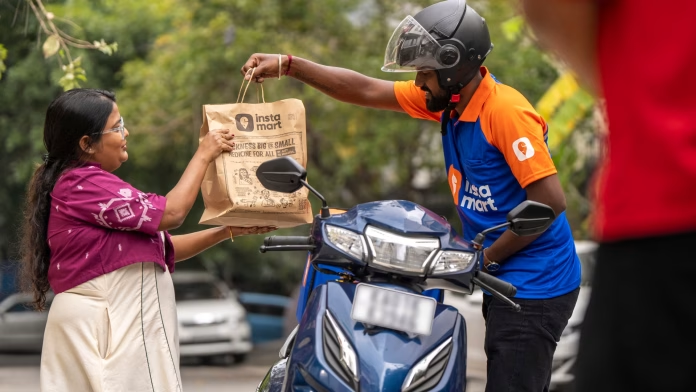
Food delivery and services platform Swiggy has raised ₹10,000 crore through a qualified institutional placement, marking one of the largest recent capital infusions in India’s consumer internet sector. The fundraise strengthens Swiggy’s financial position as it sharpens focus on quick commerce, a segment that has become central to the country’s urban consumption story.

The capital raised is expected to be channelled primarily into scaling Swiggy Instamart, the company’s quick commerce arm. Key areas of investment include the expansion of dark store infrastructure, improvements in last-mile delivery capabilities, and upgrades to technology and supply chain systems aimed at handling higher order frequency and faster fulfilment timelines.

Quick commerce has rapidly shifted from an experimental category to a core growth engine within India’s food and grocery delivery ecosystem. Rising demand for instant access to daily essentials, coupled with growing comfort around frequent, small-ticket purchases, has made speed and availability critical differentiators. This has also driven up operating intensity, with companies investing heavily in warehousing density, rider availability, and backend efficiencies.

Swiggy’s latest capital raise provides the company with the financial headroom to absorb near-term costs while pursuing scale in a market where customer expectations continue to rise. The funds are also expected to give Swiggy greater flexibility to respond to competitive pressures as the sector moves towards consolidation.

While Instamart remains a priority, the company is also expected to continue selective investments across its broader platform, ensuring that its food delivery, grocery, and emerging services businesses remain competitive.

The QIP underscores sustained institutional confidence in Swiggy’s long-term strategy, even as the quick commerce segment demands significant capital and operational discipline. As competition intensifies, the company’s ability to translate scale into efficiency will be closely watched by both investors and the wider industry.

Advertisement

Zepto Readies Confidential IPO Filing, Targets $500 Million Raise in Mumbai

0

Indian quick-commerce startup Zepto Ltd. is reportedly gearing up to file for an initial public offering of roughly $500 million in Mumbai as early as next week, according to sources familiar with the matter. The filing is expected to include both a fresh issue and secondary share sales by existing investors, with proceeds earmarked for scaling operations and expanding the company’s rapid grocery delivery network.

Zepto, known for its 10-minute grocery delivery service, is working closely with Axis Bank Ltd., Motilal Oswal Investment Advisors Ltd., and the Indian units of Morgan Stanley, HSBC Holdings Plc, and Goldman Sachs Group Inc. to submit its draft prospectus via a confidential route. While deliberations on the final timing and size of the IPO remain ongoing, the filing signals a major milestone for the startup, which has emerged as one of India’s fastest-growing quick-commerce players.

The proposed public listing comes shortly after Zepto’s $450 million funding round in October 2025, which valued the company at $7 billion. The capital raised then enabled Zepto to expand its warehouse network, strengthen last-mile delivery capabilities, and compete aggressively with global and local rivals.

India’s quick-commerce market is witnessing rapid growth, driven by rising urban demand for groceries, daily essentials, and household products delivered within minutes. Zepto competes with Amazon India, Swiggy, Zomato, and BigBasket, all of which are investing heavily in logistics infrastructure, micro-fulfillment centers, and technology platforms to capture market share.

Global investors, including SoftBank Group Corp. and Temasek Holdings Pte., have poured billions into India’s fast-moving delivery sector, underscoring the market’s strategic importance and the intense competition. Zepto’s planned IPO will test investor appetite for quick-commerce in India and could mark a landmark moment for startups attempting to combine speed, convenience, and scale in a single business model.

Advertisement

Underneat Raises $6 Million from Fireside Ventures, Achieves ₹150 Crore ARR in Eight Months

0

Shapewear brand Underneat, co-founded by digital creator Kusha Kapila and entrepreneur Vimarsh Razdan, has secured USD 6 million in a Pre-Series A funding round led by Fireside Ventures. The Bengaluru-based startup reported crossing ₹150 crore in annual recurring revenue within just eight months of operations, achieving EBITDA positivity in the same period.

Founded in April 2025, Underneat operates in the growing segment of affordable, high-quality shapewear in India. The brand has quickly carved a niche by combining accessible pricing with direct-to-consumer digital engagement. Its success has been amplified by Kapila’s social media presence, particularly her Instagram series “What to Wear Under,” which has played a key role in generating awareness and shaping consumer demand for the category.

The funds raised will primarily be deployed to expand operations and strengthen distribution networks across urban and emerging Indian markets. Underneat aims to scale its manufacturing, enhance logistics capabilities, and increase penetration through both online channels and select retail partnerships.

Fireside Ventures, known for backing consumer-focused brands such as Mamaearth, Sleep Company, and Yoga Bar, sees Underneat as a structurally underrepresented category in India’s fashion and personal care market. Adarsh Menon, Partner at Fireside Ventures, stated that the brand demonstrates strong product leadership, disciplined execution, and early signs of scalable growth. “Underneat is addressing a clear consumer gap while building a category with potential for long-term leadership,” he added.

Since its launch, Underneat has leveraged customer feedback to refine its product fit, comfort, and design, creating a loop of repeat purchases and brand loyalty. The co-founders emphasize that the brand’s growth trajectory is built in collaboration with its customers, who help shape product innovation.

With Fireside Ventures’ backing, Underneat plans to consolidate its market position and drive category expansion, positioning itself as a leading player in India’s shapewear market.

Advertisement

FSSAI Orders Nationwide Testing of Eggoz Eggs as Carcinogen Concerns Trigger Regulatory Scrutiny

0

India’s food regulator has stepped in amid growing scrutiny around the safety claims of Eggoz, a Bengaluru based egg startup. The Food Safety and Standards Authority of India has directed its regional offices to collect samples of both branded and unbranded eggs from across the country following concerns around the possible presence of carcinogenic substances.

According to sources cited by news agency ANI, the collected samples will be tested at ten laboratories nationwide. The primary focus of the testing will be on nitrofurans, a class of antibiotics that are banned for use in food producing animals due to their potential cancer causing properties. The move comes after social media chatter and consumer reports triggered questions about egg safety standards and sourcing practices in the poultry sector.

Eggoz, which positions itself as a premium and traceable egg brand, has strongly denied the allegations. Over the weekend, the company released test reports from a NABL accredited laboratory stating that carcinogenic compounds in its eggs were below the limit of quantification. The startup added that the testing covered a wide range of parameters including microbiological safety, chemical composition, heavy metals, antibiotic residues, pesticides, natural toxins and other contaminants.

The company has maintained that its products are safe for consumption and compliant with Indian food safety norms. Industry observers note that while regulatory testing is routine, public scrutiny has intensified as food startups scale rapidly and market transparency becomes a key differentiator.

The FSSAI’s findings are now awaited closely, not just by Eggoz but by the broader poultry and foodtech ecosystem. The outcome could influence future testing protocols, consumer trust, and how food brands communicate safety claims in an increasingly aware market.

Advertisement

Hugo Blue Opens Its First-Ever Global Store in India at DLF Avenue Saket, Marking Retail Debut for HUGO BOSS Youth Line

0

Hugo Blue, the newest youth-oriented line from the HUGO BOSS stable, has made its first-ever physical retail debut globally in India, opening a standalone store at DLF Avenue, Saket in New Delhi. The launch has been executed by Reliance Brands Limited, reinforcing India’s growing role as a priority market for international fashion labels testing new concepts.

Hugo Blue was first unveiled in May 2023 as part of HUGO’s broader brand refresh, with its debut collection rolling out globally in Summer 2024. Positioned as a denim-led extension of the HUGO brand, the line is designed around relaxed silhouettes, unisex appeal and influences drawn from street culture, aimed squarely at Gen Z and young millennial consumers. Before the store opening, the collection had been available internationally through select retail partners and online channels. In India, it debuted digitally via Ajio Luxe.

The opening of the Delhi store marks Hugo Blue’s shift from digital and wholesale visibility to a full-fledged experiential retail format. Located within DLF Avenue, a mall known for its strong fashion and lifestyle mix, the store is designed to connect with younger, style-conscious shoppers through curated merchandising and a focused product edit.

Reliance Brands’ strategy with Hugo Blue centres on three priorities: positioning India as a global-first launch market, building relevance with a younger demographic, and using physical retail to clearly differentiate sub-brands within larger fashion houses. The move also strengthens Reliance Brands’ presence in the contemporary and bridge-to-luxury segments, while expanding its denim and casualwear portfolio.

For HUGO BOSS, the decision to open the world’s first Hugo Blue store in India reflects shifting industry dynamics. With a large Gen Z population, rising appetite for premium fashion and mature mall infrastructure, India is increasingly being viewed not just as a growth market, but as a launchpad for new global retail concepts.

Advertisement